Powerloom vs Handloom Silk Sarees: How to Split Your Stock
6 October 2026 · 7 min read
తెలుగులో చదవండిGoogle TranslateIn short: Handloom silk sarees are woven by hand and sell on story and craft. Powerloom ones match design to design and sell on volume. Most shops should stock both, leaning on the one their customers ask for.
If you buy silk sarees for a shop, you've heard both words from every supplier. The trouble is that handloom and powerloom sarees can look alike on a rack, and the label on the box is often the only thing telling them apart. This post is for the shop owner who has to put real money behind one or the other.
What actually differs
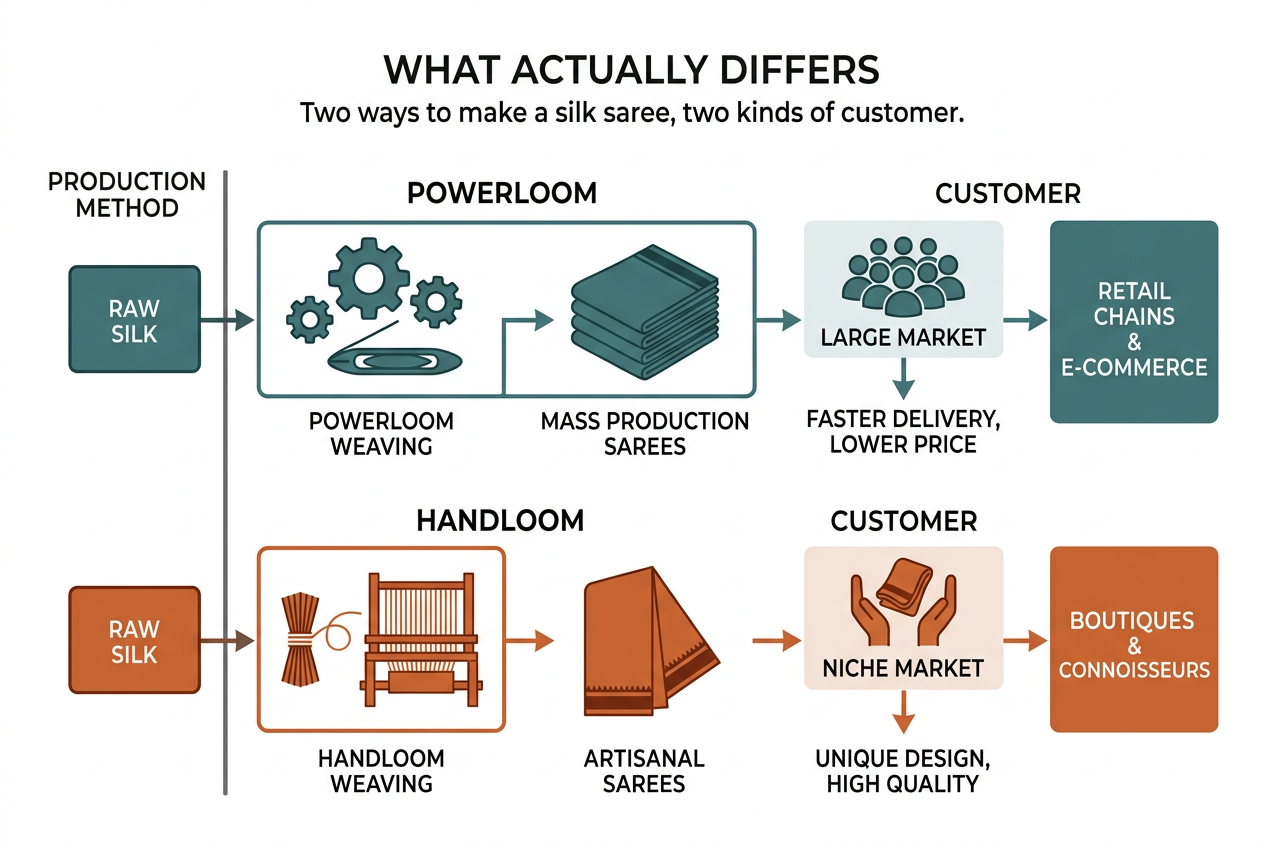
A loom does one job: it crosses the weft threads over the warp. On a handloom, the weaver does that crossing with their hands and feet. On a powerloom, a motor does it. Indian law draws the line in the same place. The Handlooms (Reservation of Articles for Production) Act of 1985 defines a handloom as any loom other than a power loom.
That one difference spreads into everything else a buyer cares about:
- Time. One handloom saree takes a weaver days. In that same stretch, a powerloom produces many.
- Consistency. Powerloom sarees in a set match each other closely. Handloom ones carry small differences from piece to piece.
- Feel. Handloom cloth tends to be softer and more supple, while powerloom cloth is crisper and more even.
- Story. Handloom comes with a weaver, a region and a method, which you can tell your customer. Powerloom sells on design, colour and how well it's made.
Neither is the "real" silk saree. Two ways of making one. They suit two different kinds of customer, and a shop that understands which customer is standing at the counter on a given Saturday, with a festival close and a budget already in mind, will pick the right piece far more often than a shop that treats every buyer the same.
How to identify them when you hold the saree
I wouldn't trust any single test on its own. Use several, and treat them as a reason to ask questions rather than a verdict.
- Turn it over. In a handwoven saree the design is part of the cloth, so the pattern shows on both sides. A flat or printed-looking back, or long loose threads floating behind a motif, points to machine work. Be careful, though: jacquard weaving, by hand or by machine, can leave floats at the back.
- Look at the selvedge. That's the finished edge along the length. On a handloom it's often slightly uneven, with small knots where threads were joined. A power loom gives a dead-straight edge.
- Look for small irregularities. Slightly uneven thread spacing, or a border that wanders a hair. On a handloom these are the sign of a person at work. On a powerloom piece they shouldn't be there at all.
- Study the zari. In handwoven borders and pallus the metallic thread is worked into the cloth and catches light with some depth. On cheaper machine pieces it can look flat, as if it were laid on top.
- Compare pieces in the set. Open four or five sarees from the same box. If the motifs are identical down to the spacing, you're almost certainly looking at machine weaving. Some difference between pieces is normal for handloom.
- Look for the Handloom Mark. This is the only test that rests on paperwork rather than your eye.
The Handloom Mark
The Handloom Mark scheme was launched on 28 June 2006. The Development Commissioner (Handlooms) promotes it, and the Textiles Committee, a statutory body of the Ministry of Textiles, implements it. A mark on the label tells a buyer the product is genuinely handwoven.
The rules are tightening. Draft regulations from the Ministry of Textiles, the Handloom Mark Standards (Labelling and Display), would need the label on anything described or sold as handloom, and would bar anyone from using it without registration. At the time of writing these were still drafts, so check the current position before you rely on them. Either way, the lesson for a shop owner is the same. If a supplier says "handloom", ask for the label and for the weaver's or society's registration.
Why your eye is not enough
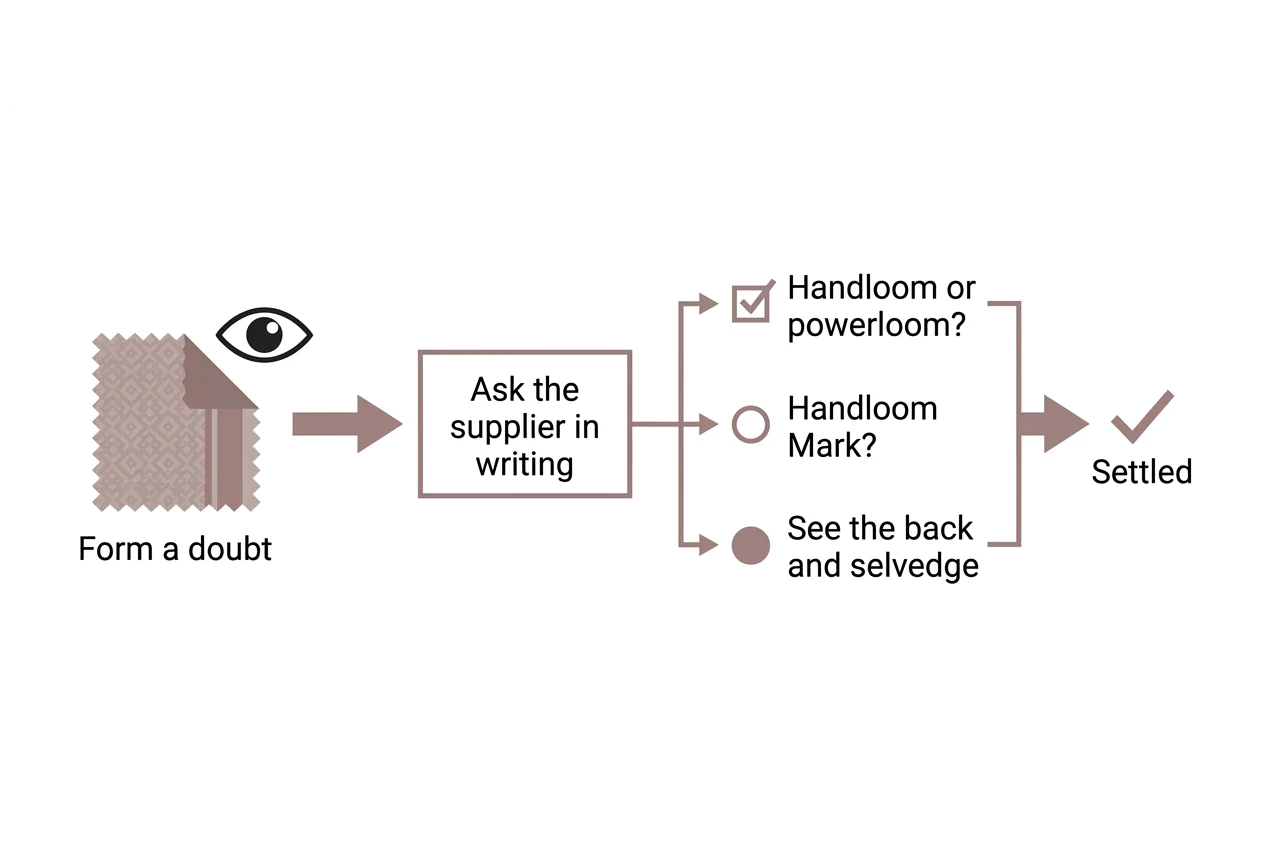
Good powerloom work can be very fine, and a rushed handloom piece can look plain. So the honest answer to "how do I identify it" is this: use your eye to form a doubt, and use the supplier to settle it. Ask three things in writing before you place an order:
- Is each saree in this set handloom or powerloom?
- If handloom, does it carry the Handloom Mark?
- Can I see the back of the cloth and the selvedge on a few pieces from this box?
A supplier who's straight about this will answer in a line. A vague answer tells you something too.
The buying decision points
Before you choose, sit down with your own sales book and answer these.
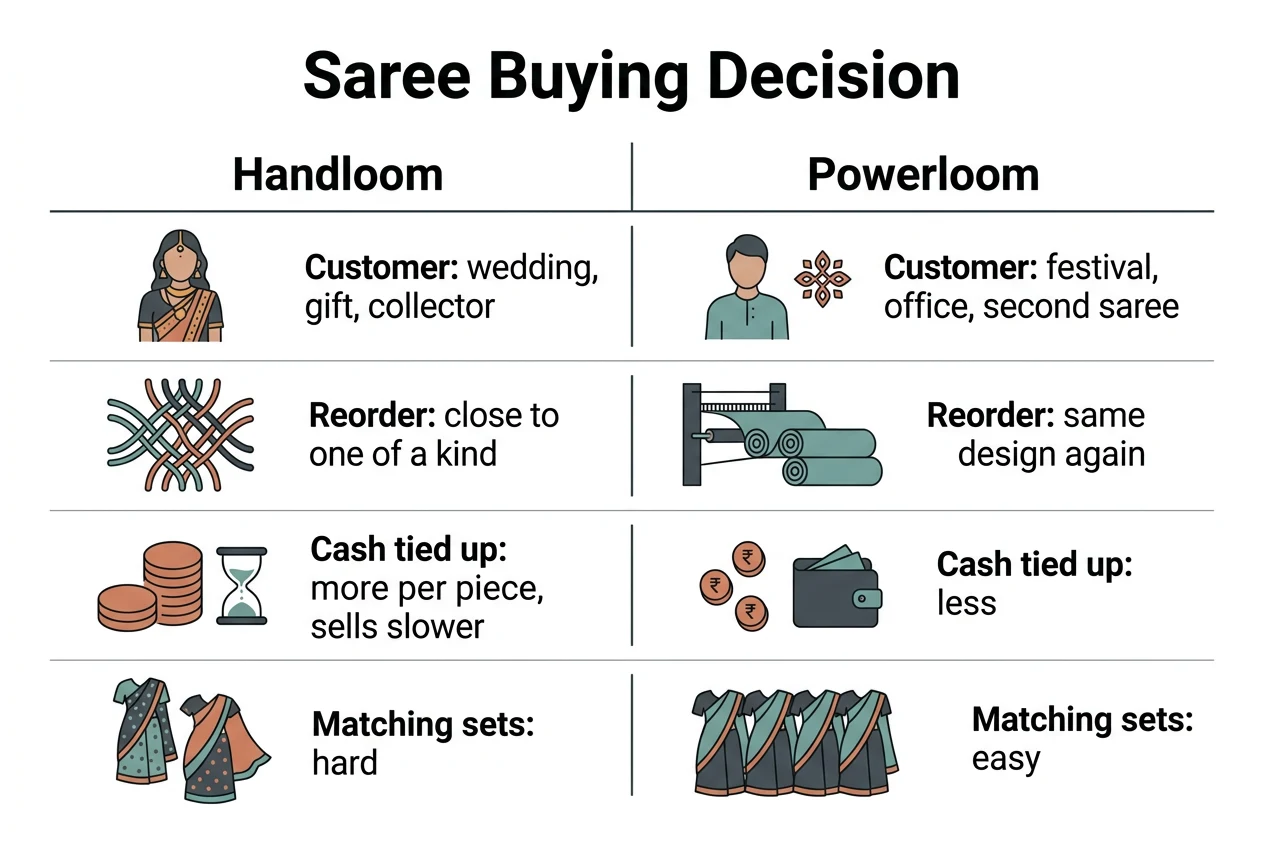
- Who walks into your shop? Someone shopping for a wedding, a gift or a collector's piece will often pay for the story of a handloom saree. Someone shopping for a festival, an office function or a second saree often wants colour, design and a fair price.
- How fast does your stock turn? Powerloom sarees are easier to reorder in the same design, so a fast mover can be refilled. Handloom is closer to one of a kind.
- How much can you tie up? Handloom stock holds more of your money per piece and sells more slowly. If your cash is thin, that matters.
- Can your staff explain it? If your team can't say why one saree is handwoven and another isn't, the handloom story is wasted. Teach them the tests above.
- Do you need matching pieces? Boutiques and resellers who sell to groups, such as a wedding party or a uniform order, need sarees that match. That's powerloom territory.
- Can you prove what you sell? Calling a powerloom saree handloom is the fastest way to lose a customer. Only tell the handloom story for pieces you can back with a label or a weaver's name.
How to split your silk sarees stock between the two
I have no sales data to give you, so treat what follows as a starting rule rather than a fact. Your own shelf will correct it within a season.
Start from your customer, not from the supplier. Look at the last few months of sales and sort them into two piles: pieces bought for the story, and pieces bought for the look. Your stock should roughly follow that split.
Here are a few starting points:
- A new shop with no sales history: lean towards powerloom, perhaps two parts to one. It costs less per piece, it moves faster, and it teaches you your colours before you commit to slower stock.
- An established shop with loyal customers who ask for handloom: reverse that, and keep powerloom as the filler that brings in walk-ins.
- A shop in a town with a festival and wedding rhythm: keep the handloom slice for the wedding months and let the powerloom slice carry the rest of the year.
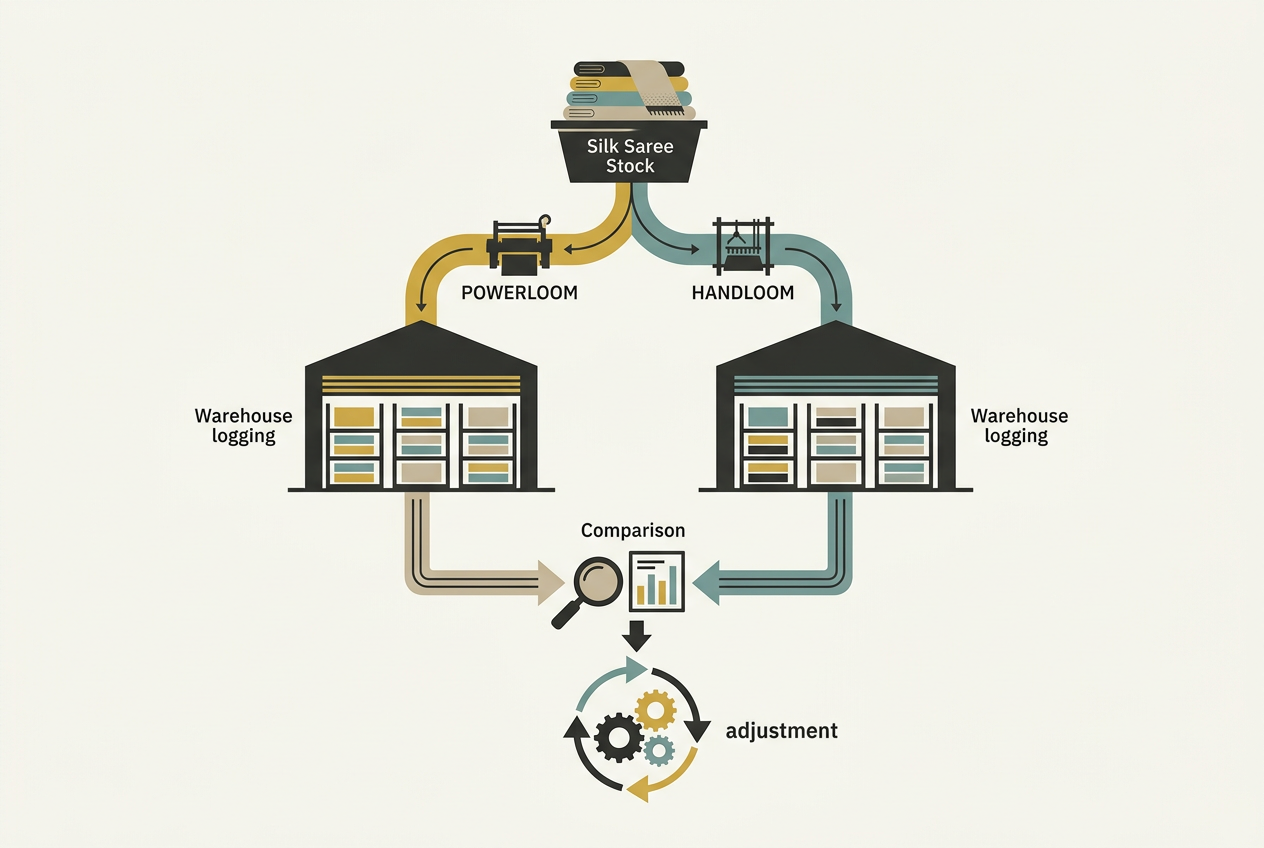
Then run the split as an experiment:
- Buy both in your first order, even if the handloom share is small.
- Keep the two groups separate in your stock book, so you can see which one sold.
- After one season, compare how many of each you sold against how many you bought.
- Shift the next order a notch towards whichever sold through, and no more than a notch.
Don't drop one side completely. Only powerloom on the shelf, and you lose the customer who wants a handwoven piece; only handloom, and you lose the one who wants ten matching sarees on Friday.
Buying in sets
Many wholesale suppliers sell silk sarees in boxed sets, so your split is made in whole boxes, not single pieces. Ask what a set contains and whether it can mix designs and colours. A box is a bigger commitment than one saree. One box of each in a first order is a sensible way to learn.
What to do next
Pick one supplier and ask the three questions above. Open a box. Turn the sarees over. Look at the edge. You'll learn more from twenty minutes with the cloth than from any article, including this one.
If you want to see how a Rayadurg saree house describes its own weaving, silksaree.shop lists its collections and takes enquiries on WhatsApp. Ask what is power loom and what is handloom, and expect a plain answer.