
Handloom Sarees: What Makes One Handloom, and How to Buy
11 October 2026 · silksaree.shop · 5 min read
తెలుగులో చదవండిGoogle Translate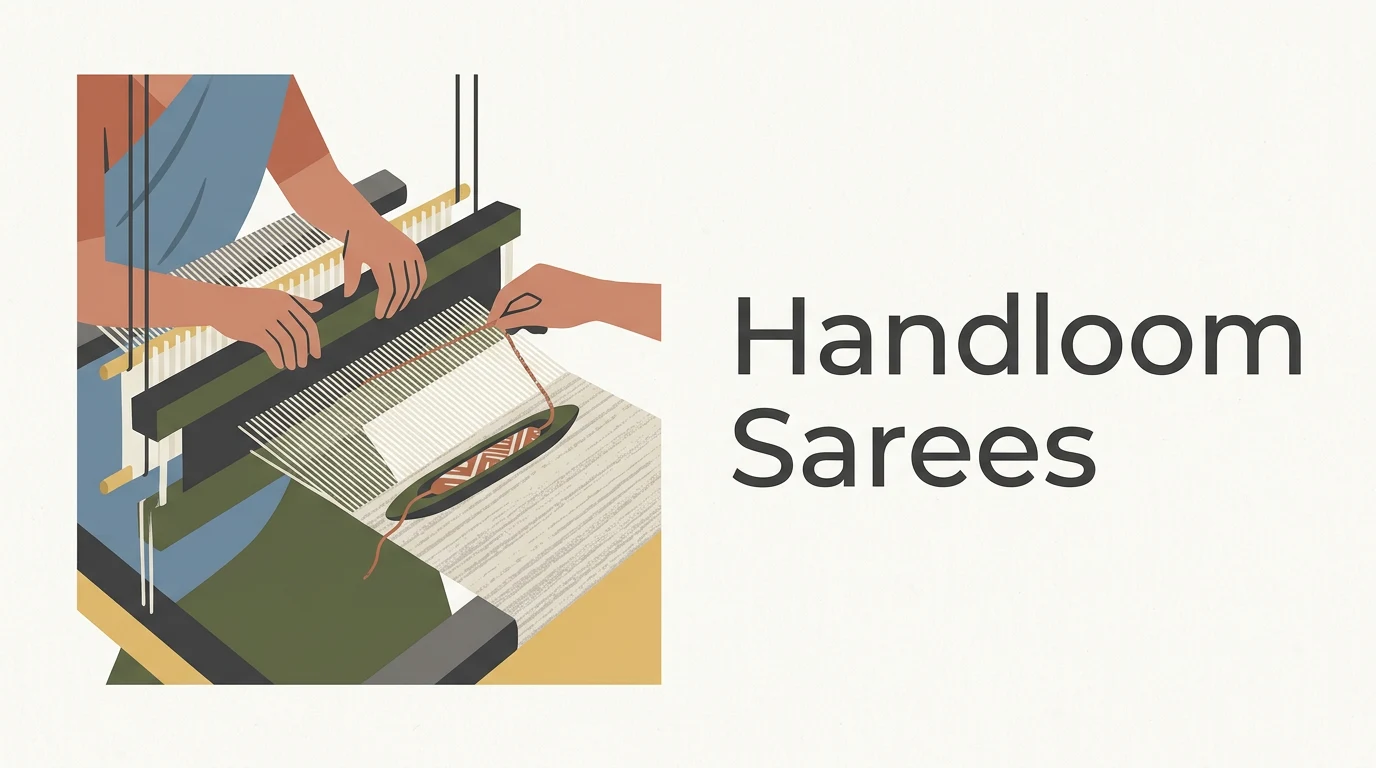
In short: Handloom sarees are woven on a loom worked by hand, with no motor. Ask for the Handloom Mark and check the back of the cloth. Buy by weave type, not by the word "handloom" alone.
If you stock handloom sarees, your customers will ask what makes them handloom, and "woven by hand" is only half an answer. Suppliers use the word loosely. Labels are easy to print, and a rack of silk can look the same from the front. This post is for the shop owner who wants to answer that question with confidence and buy the right pieces.
What "handloom" actually means
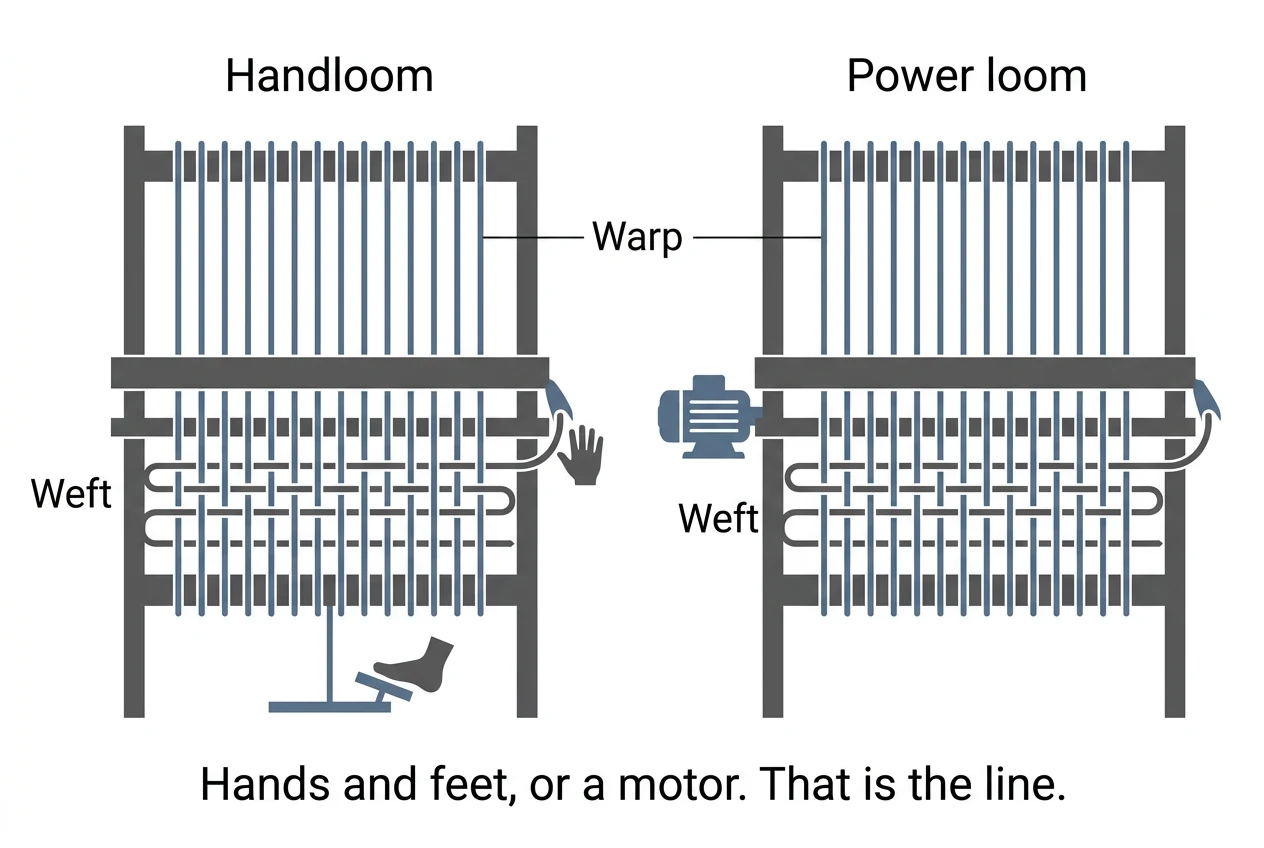
A loom holds the long threads, the warp, tight. The weaver passes the weft across them, thread by thread, and beats it down. On a handloom, hands and feet do that work. On a power loom, a motor does. That's the whole line between them.
The law draws it the same way. The Handlooms (Reservation of Articles for Production) Act, 1985 treats a handloom as any loom that is not a power loom.
Two things follow that surprise new buyers. Handloom isn't a fibre: a handloom saree can be silk or cotton, or a blend of the two, because the word describes how the cloth was made, not what it's made of. And handloom doesn't mean plain. Heavy zari borders and brocade are woven by hand, and so is ikat. What takes the time is the setting up, with threads dyed and tied before the first row of weft goes in.
Because the work is slow and done by a person, small differences show up from piece to piece. A border sits a hair differently. A motif is spaced slightly apart. Buyers who love handloom love exactly that.
The weaves you'll hear at the counter
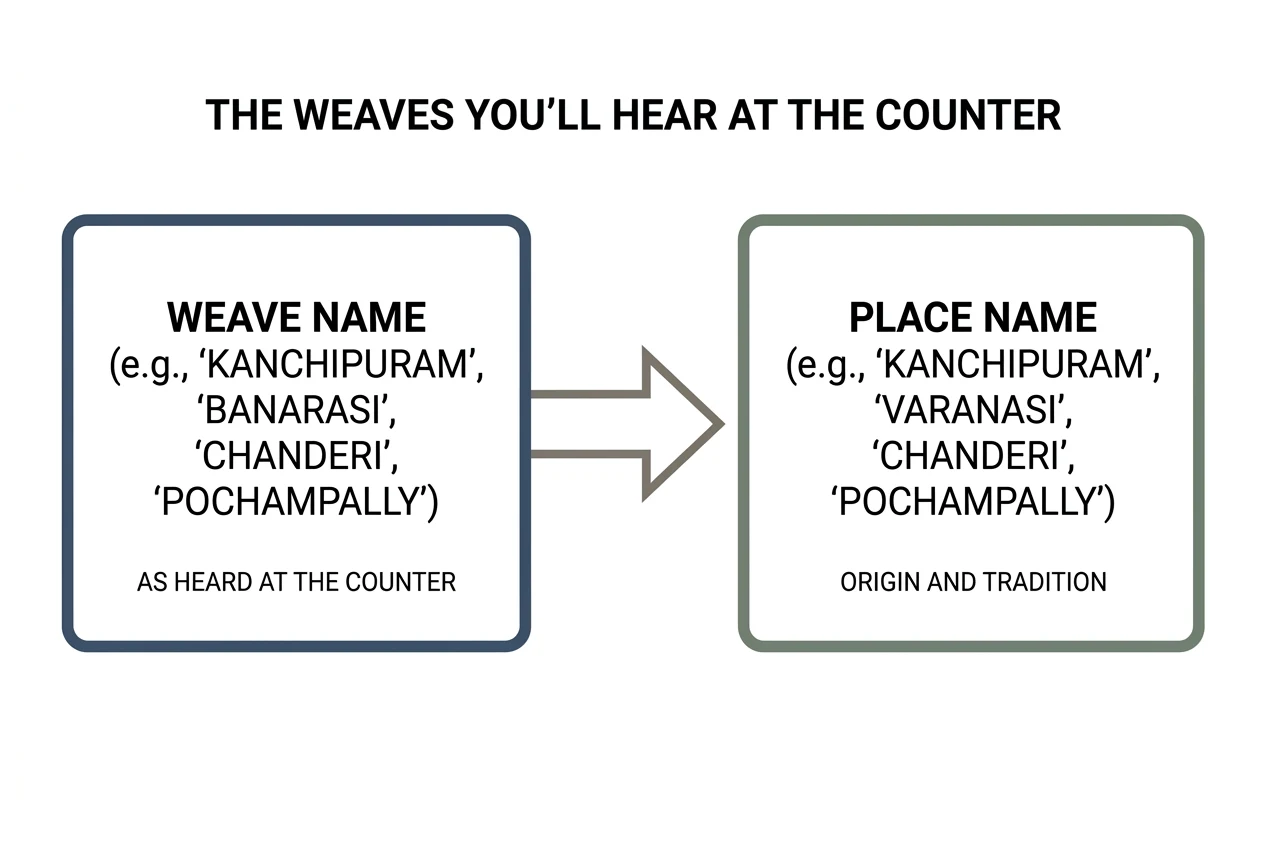
Handloom sarees are usually sold by the name of the weave, and the name points to a place. You don't need to stock all of them. You do need to recognise the ones your customers will name.
- Kanchipuram (Tamil Nadu): heavy silk with contrast borders and rich zari.
- Banarasi (Uttar Pradesh): brocade work, with dense patterns in the body and pallu.
- Pochampally ikat (Telangana): patterns made by dyeing the threads before weaving, so the edges of each motif look softly blurred.
- Chanderi (Madhya Pradesh): light, sheer cloth that suits warm weather.
- Paithani (Maharashtra): known for peacock and flower motifs in the pallu.
- Sambalpuri (Odisha): ikat work again, in a different regional style.
Several of these names are registered as geographical indications, which means the name is meant to be used only for cloth from that place, so before you call a saree by one of these names in your shop, ask your supplier where it was woven and check the register at ipindia.gov.in for the exact product.
How to check a piece before you buy
No single test settles it. Use a few, and treat each as a reason to ask a question, not as a verdict.
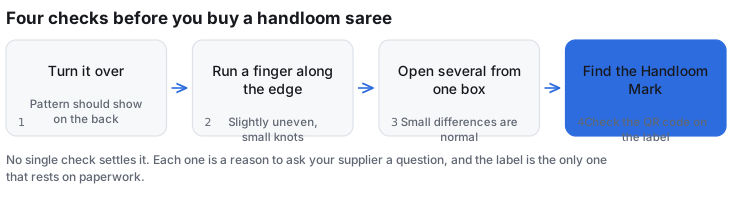
Turn the saree over first. In handwoven cloth the pattern is part of the weave, so the back shows it too. Long loose threads floating behind a motif can point to machine work, though jacquard woven by hand can leave them as well.
Then run a finger along the edge. The selvedge is the finished edge down the length, and on a handloom it can be slightly uneven, with small knots where threads were joined.
Open several sarees from one box. If the motifs match down to the spacing, think machine. Small differences are normal for handloom. Look at the zari too: metallic thread worked into the cloth has some depth, while thread that looks laid on top of it looks flat.
Last, find the label. The Handloom Mark is the one check that rests on paperwork instead of your eye.
The Handloom Mark
The Handloom Mark is a label run by India's Ministry of Textiles through the Textiles Committee. It's meant to tell a buyer that a product is genuinely handwoven. The Committee also has a customer app that reads the QR code on the label, which shows details of the weaver for a genuine product and warns you about a fake label.
A label helps. A label isn't the cloth, though. If a supplier says a set is handloom, ask for the Mark and look at the back of two or three pieces yourself.
How to buy handloom sarees for your shop
Handloom stock holds more of your money per piece and often sells more slowly than machine-woven stock, so buy with a plan.
- Start from your customer. Wedding and gift buyers often pay for the story behind a piece, while festival and office buyers often want colour and design first.
- Pick one or two weaves and learn them. It's better to explain Pochampally ikat well than to carry six weaves your staff can't describe.
- Ask three questions in writing. Is each saree in this set handloom or power loom? Does it carry the Handloom Mark? Can I see the back and the edge on a few pieces?
- Keep handloom in its own stock-book line. After one season you'll see what sold, not just what you believe sold.
- Never sell power loom as handloom. It's the quickest way to lose a customer who knows the difference, and a good customer usually does.
Many wholesale houses sell in boxed sets, so your first handloom order may be a full box. Ask what the set contains and whether designs and colours can be mixed. For a fuller way to divide your shelf between the two kinds of loom, read Powerloom vs Handloom Silk Sarees: How to Split Your Stock. If you're still working out how much stock to start with, How to Start a Saree Business walks through three budgets.
What to do next
Take one saree you already stock. Turn it over, check the edge, look for the label. Do it with your staff, so the whole shop learns the same words.
If you'd like to see how a saree house in Rayadurg describes its own weaving, silksaree.shop is mostly power loom with some handloom, takes enquiries on WhatsApp, and will tell you which is which.