
How to Start a Saree Business: Cost, Profit & Steps (2026)
7 October 2026 · silksaree.shop · 22 min read
తెలుగులో చదవండిGoogle Translate
In short: To start a saree business in India, choose a model (home reselling, online store or shop), set a budget (₹25,000, ₹1 lakh or ₹5 lakh+), buy a first lot from a wholesale hub such as Surat or Varanasi, register GST and Udyam once you sell online, price at a 30 to 50% margin, and sell through WhatsApp, Instagram, Meesho or a shop.
Most guides to the saree business give you a range so wide it is useless. "₹50,000 to ₹10 lakh" does not tell a woman working from her living room what to buy on Monday. This guide gives three budgets, itemised line by line, and then follows one month of sales to the last rupee.
It is written for two readers: someone at home who wants to start selling sarees on a small budget, and someone who already runs a small clothing shop and wants to add sarees properly. Prices and margins below are planning figures, not quotes. Margins change by town, supplier and season, so treat every number as a starting point and replace it with your own quotes.
Last updated: 30 October 2026. Written by: the silksaree.shop team.
The three plans at a glance
| Budget | Model | Stock you hold | Realistic monthly profit |
|---|---|---|---|
| ₹25,000 | Saree business at home, sold on WhatsApp and Instagram | About 25 cotton and printed sarees | ₹3,000 to ₹6,000 |
| ₹1,00,000 | Online saree business on Instagram plus Meesho or Flipkart | About 90 sarees across 4 to 5 fabrics | ₹13,000 to ₹15,000 |
| ₹5,50,000 | A small saree shop | ₹3 lakh or more of stock, silk and bridal included | ₹25,000 to ₹45,000 after rent and staff |
The monthly figures are my own estimates from the cost tables below. The middle one is worked out in full later, so you can check the arithmetic.
Is a saree business profitable in India? The quick numbers
Yes, if you control three things: returns, dead stock and ad spend. Demand is not the problem. IMARC Group values the Indian saree market at USD 6.15 billion in 2025 and expects about USD 10.77 billion by 2034, growing at 6.43% a year from 2026. IMARC's report page was dated 1 October 2026 when I read it.
Three more figures from the same report matter for a beginner:
- Cotton is the biggest fabric, at 23% of the market.
- Economy sarees make up 55% by price band. Most buyers are shopping for value, not for a ₹15,000 piece.
- Offline sales are 65% of the market. Online is growing, but most sarees are still bought by touching them.
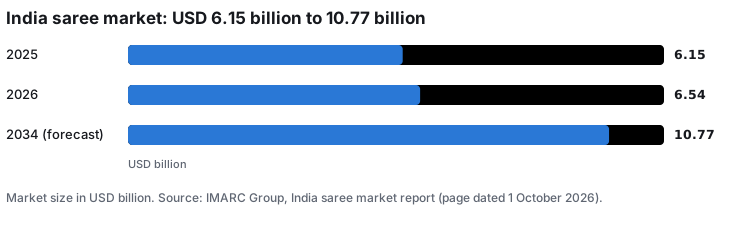
3 lakh people search Google for sarees every month
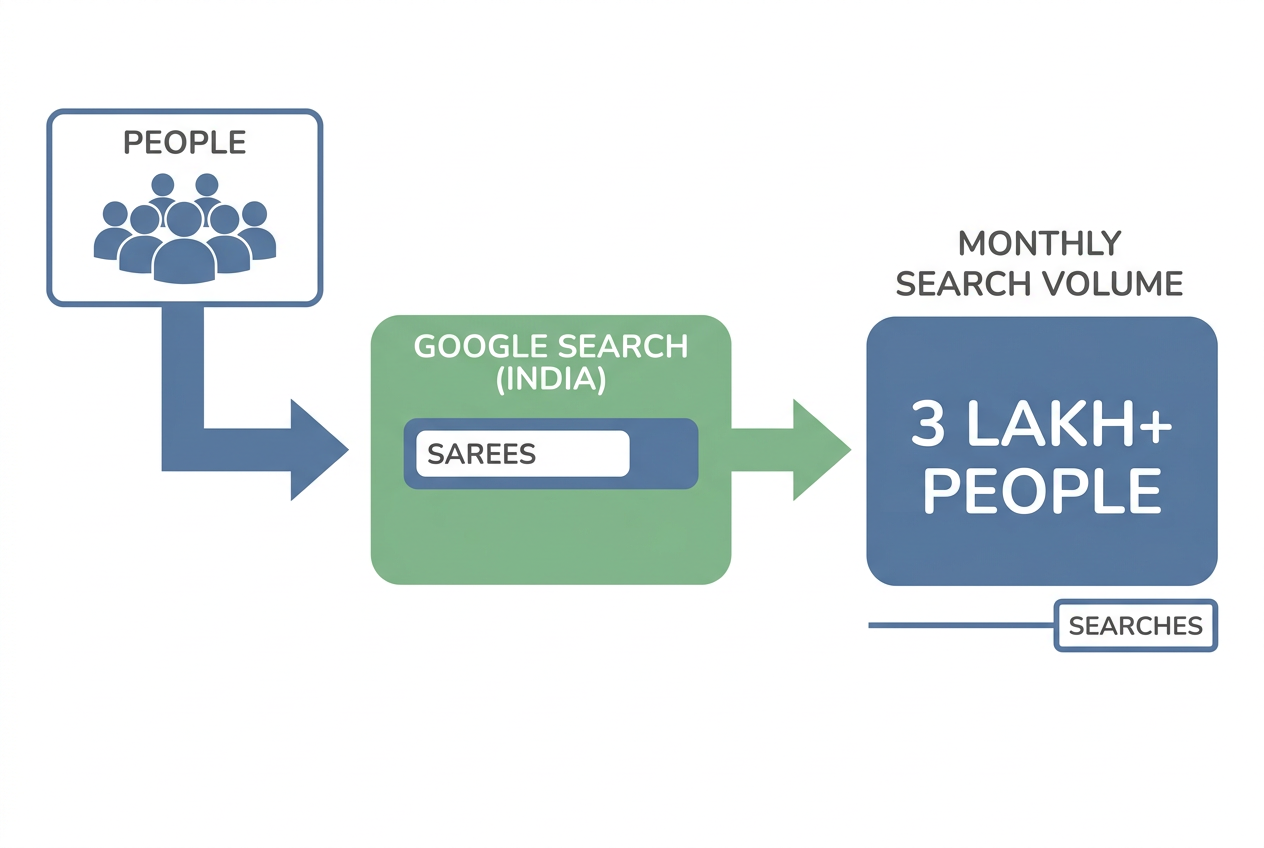
That is the demand, visible in Google. These are people typing "saree" into the search box before they buy, so a seller with a clear photo and a fair price meets them while they are still choosing. A shop serves only the people who walk past it. A WhatsApp catalogue and an Instagram page can serve the people who search.
Treat 3 lakh as the size of the crowd, not your sales. Most searchers will buy from someone else, and the rest will pick you only if your photos, prices and replies beat the next seller's.
Demand also comes in waves. Wedding season, Diwali, Onam, Pongal and Durga Puja each pull a different kind of buyer, and I come back to that calendar further down.
So is saree business profitable or not? A saree business is profitable when you buy what your customers already ask for, sell most of it at full price and keep returns low. It loses money when you buy 60 trendy designs, discount half of them and pay for ads that bring buyers who send everything back.
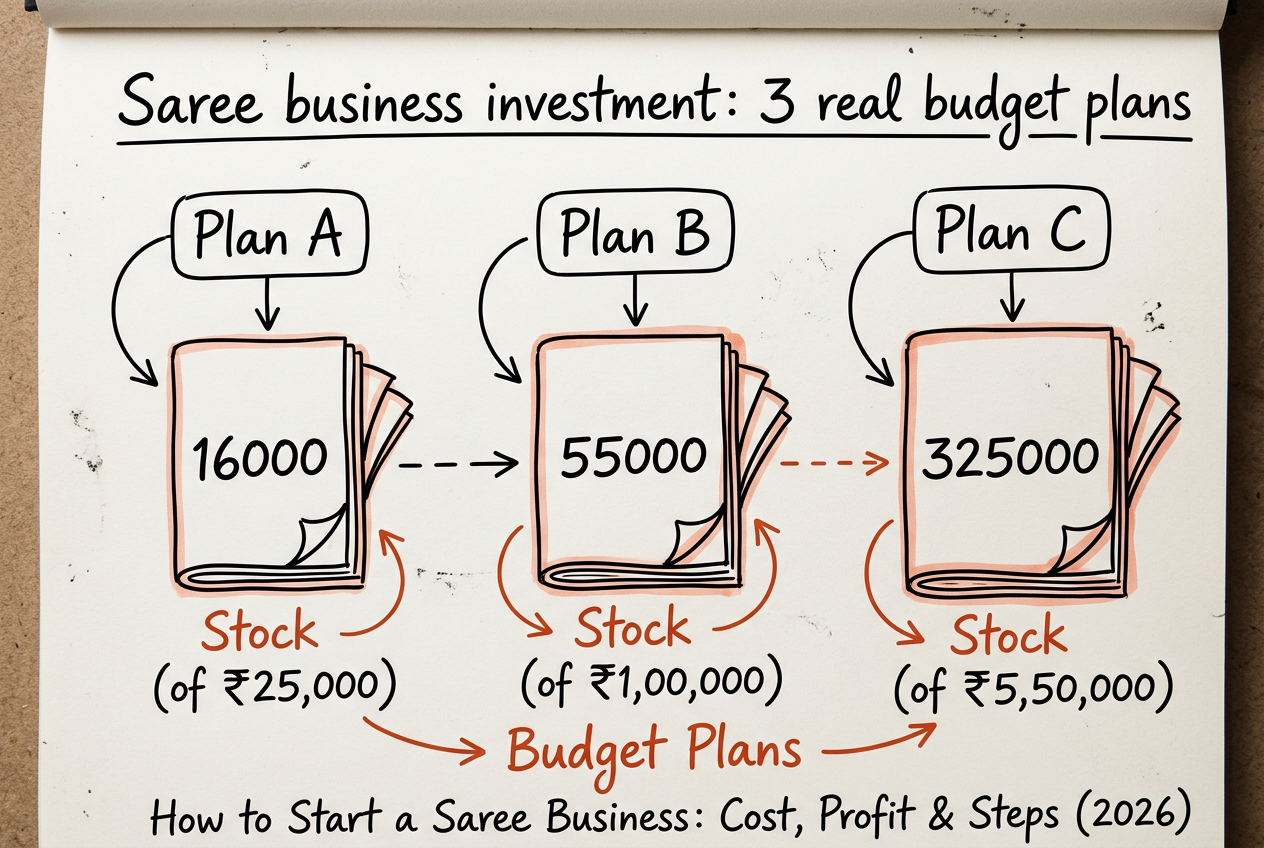
Saree business investment: 3 real budget plans
The first question every beginner asks is the saree business minimum investment. For stock alone, you can begin with ₹15,000 to ₹20,000. Add packaging, a way to photograph the sarees and a little marketing, and ₹25,000 is a fair floor.
Here is each plan split by cost heading. Every column adds up to its total.
| Cost heading | Plan A: home | Plan B: online | Plan C: shop |
|---|---|---|---|
| Stock | ₹16,000 | ₹55,000 | ₹3,25,000 |
| Packaging | ₹1,500 | ₹6,000 | ₹10,000 |
| Photography and signage | ₹1,000 | ₹5,000 | ₹15,000 |
| Marketing and launch | ₹2,500 | ₹12,000 | ₹25,000 |
| Registration and paperwork | ₹0 | ₹4,000 | ₹10,000 |
| Fit-out and rent deposit | ₹0 | ₹0 | ₹1,10,000 |
| Staff, first two months | ₹0 | ₹0 | ₹30,000 |
| Buffer for returns and reorders | ₹4,000 | ₹18,000 | ₹25,000 |
| Total | ₹25,000 | ₹1,00,000 | ₹5,50,000 |
The buffer is the line beginners cut first and regret most. It pays for return shipping, a reorder of a fast mover and the first month when sales are slow.
Plan A: ₹25,000, a saree business at home (WhatsApp and Instagram)
This is the saree business for women who want to start from home with low investment, and it needs no shop, no staff and no registration to begin.
What you buy: 20 to 30 cotton and printed sarees, at roughly ₹500 to ₹800 each. Cotton is the easiest first fabric for a home seller. It is light to ship, it suits every season and a customer needs no special occasion to buy one. Cotton saree business at home works because the price is low enough for a regular customer to buy without a long think.
How you sell:
- Photograph each saree in daylight, flat on a clean sheet and then draped on a person, with a phone on a cheap tripod.
- Make a WhatsApp Business catalogue with a price on every item.
- Post one reel a day on Instagram, showing the saree being opened, draped and turned.
- Send a weekly broadcast to everyone who has ever messaged you.
What it earns: if you sell all 25 sarees at about ₹1,000 each against a cost of ₹640, the gross profit is about ₹9,000. That usually takes two months at the start, so ₹3,000 to ₹6,000 a month after small costs is realistic. The real gain is that you reinvest it, and the second lot sells faster because you now know your buyers.
If you want to start with even less, there is a reselling route where you carry no stock and earn a smaller commission per piece.
Plan B: ₹1 lakh, an online saree business (Instagram plus Meesho or Flipkart)
This is how to start a saree business online once you are past the first few friends and neighbours. It needs more stock, because online buyers want choice, and it needs GST if you sell on Flipkart or Amazon, or ship to other states.
What you buy: about 90 sarees for ₹55,000, spread over cotton printed, cotton silk, linen and a few designer pieces. Keep six to eight pieces per design family, not one of everything.
Marketplace onboarding. Meesho's supplier site advertises zero commission, but you still pay for shipping, and return shipping on a customer return is yours. Flipkart and Amazon charge a commission and fees that change by price band, so use their fee calculators before you price anything.
GST. Sarees carry 5% GST. Sellers on Flipkart and Amazon need a GSTIN. A seller who is below the ₹40 lakh goods threshold and sells only within one state through marketplaces may be exempt from registering, but that exemption has conditions, so confirm it on the GST portal or with a CA. Also register on Udyam, which is free.
Return costs. Online saree business profit lives or dies on returns. A saree that looks coral in a bright photo and rust in a customer's bedroom comes back. Budget for 8% returns, and keep a plain video of every saree under natural light to cut that number.
Is online saree business profitable? Yes, and the next section shows by how much. The catch is that you now pay for traffic, so every rupee of ads has to earn back more than a rupee.
Plan C: ₹5 lakh and above, open a saree shop
A shop is how to open a saree business that customers can touch, and 65% of the market still buys that way. It is also the plan where a wrong guess costs the most.
What you pay for:
- Stock: ₹3 to ₹4 lakh, with a real silk and bridal range, not only cotton.
- Rent deposit and fit-out: shelving, lights, a counter, mirrors and a trial space. In my plan this is ₹1,10,000, but a deposit alone can pass that in a big-city market.
- Staff: at least one helper for the first months, so you can leave the shop to buy stock.
- Licences: a shop and establishment licence from your local authority, GST and Udyam.
Saree retail business profit margin. A shop usually earns a gross margin of 30 to 40% on cotton and designer sarees and 25 to 30% on silk. Rent and staff then take a large share, which is why a shop needs steady footfall before it pays you. Plan for four to six months before the monthly profit settles. In my plan a shop selling about ₹2.5 lakh a month at a 32% gross margin makes ₹80,000 gross and ₹25,000 to ₹45,000 after rent, staff and power.
The silk range is what makes a shop different from an online store. A bride wants to hold the saree, see the zari in the shop light and bring her mother to approve. If you plan to stock silk, learn the difference first: Powerloom vs Handloom Silk Sarees: How to Split Your Stock explains how to tell them apart and how to split your first order.
Saree business profit margin by fabric
This is the table most guides skip: wholesale cost beside selling price beside margin, for each fabric. Margin here means gross margin on selling price, so a ₹1,000 saree bought at ₹650 has a 35% margin.
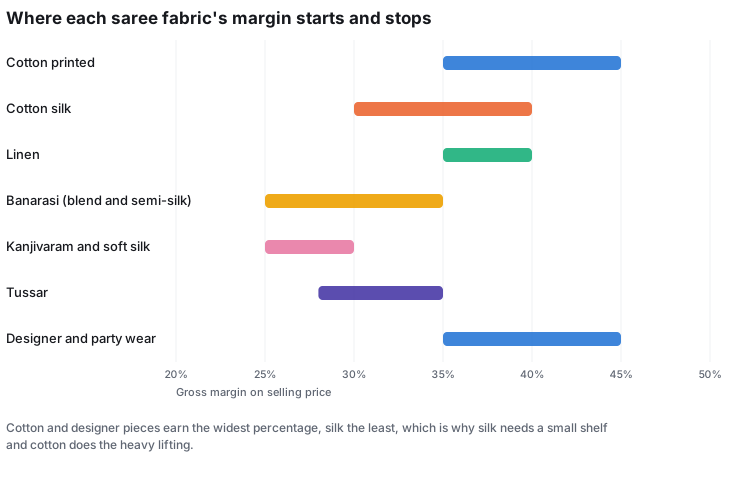
| Fabric | Typical wholesale cost | Typical selling price | Gross margin |
|---|---|---|---|
| Cotton printed | ₹250 to ₹400 | ₹450 to ₹700 | 35 to 45% |
| Cotton silk | ₹500 to ₹900 | ₹800 to ₹1,400 | 30 to 40% |
| Linen | ₹600 to ₹1,000 | ₹1,000 to ₹1,700 | 35 to 40% |
| Banarasi (blend and semi-silk) | ₹1,500 to ₹3,500 | ₹2,200 to ₹5,000 | 25 to 35% |
| Kanjivaram and soft silk | ₹2,500 to ₹6,000 | ₹3,500 to ₹8,500 | 25 to 30% |
| Tussar | ₹1,200 to ₹3,000 | ₹1,800 to ₹4,200 | 28 to 35% |
| Designer and party wear | ₹700 to ₹1,800 | ₹1,200 to ₹3,000 | 35 to 45% |
How to use these ranges. They are planning figures, not invoices, and I have not tested them in a particular market. Quotes from your own suppliers will differ, sometimes by a lot, so ask three suppliers for the same fabric before you trust any range, including mine.
Semi silk sarees: the shelf for weddings and family orders
If you want a silk look on the shelf without tying up the cash a pure silk piece needs, look at semi silk sarees. "Semi silk" has no single fixed definition. Sellers use it for a blend of silk with other fibres, so the exact mix changes from supplier to supplier. Ask what is in the cloth, and tell your customer the same thing. Never sell a blend as pure silk.
Semi silk sarees sell best when a customer buys in groups. A wedding family wants 10 to 15 matching pieces, and one saree per design cannot fill that order. Hold fewer designs, and hold each one in several colours. Semi Silk Sarees for Weddings: Stock for Family Orders shows how to stock and plan that order.
Ordering from Kenche Mallikarjuna Handlooms? The minimum order is 28 sarees (1 set). Please do not reach out for fewer than 28 sarees. WhatsApp +91 94409 21080
What does the table say about whether a silk saree business is profitable? Silk gives a lower percentage but a much bigger rupee profit per sale. A Kanjivaram sold at ₹5,500 against a ₹4,000 cost earns ₹1,500, while a printed cotton earns about ₹250. But silk ties up money for months, and one slow bridal piece can hold the same cash as 15 cotton sarees. A new seller usually does best with cotton and cotton silk as the engine and a small silk shelf for the wedding months.
A worked month: how much profit in a saree business?
This is Plan B in a normal month. I built it from the assumptions listed, and it is a model, not someone's books. Replace each line with your own numbers and you will see what your saree business monthly income looks like.
Assumptions: 60 sarees sold at an average price of ₹950, an average cost of ₹580, 8% returns and ₹4,000 spent on ads. Prices are before GST, which you collect from the customer and pass on.
| Line | Working | Amount |
|---|---|---|
| Sales | 60 sarees × ₹950 | ₹57,000 |
| Cost of sarees | 60 × ₹580 | ₹34,800 |
| Gross profit | ₹22,200 | |
| Outbound shipping you absorb | 60 × ₹40 | ₹2,400 |
| Packaging | 60 × ₹20 | ₹1,200 |
| Returns | 5 parcels at about ₹90 freight, plus one saree written off at cost | ₹1,000 |
| Ads | Instagram boosts | ₹4,000 |
| Net profit | ₹13,600 |
That is about ₹227 per saree, or 24% of sales. It is before your own time and income tax.
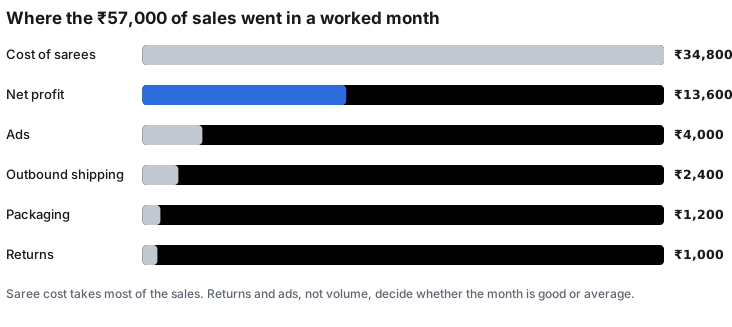
The range of ₹13,000 to ₹15,000 comes from two levers. With 4% returns and ₹3,000 of ads, the same month gives about ₹15,000. With 12% returns and ₹5,000 of ads, it falls under ₹11,000. Which means the difference between a good month and an average one is mostly returns and ads, not the number of sarees you sell.
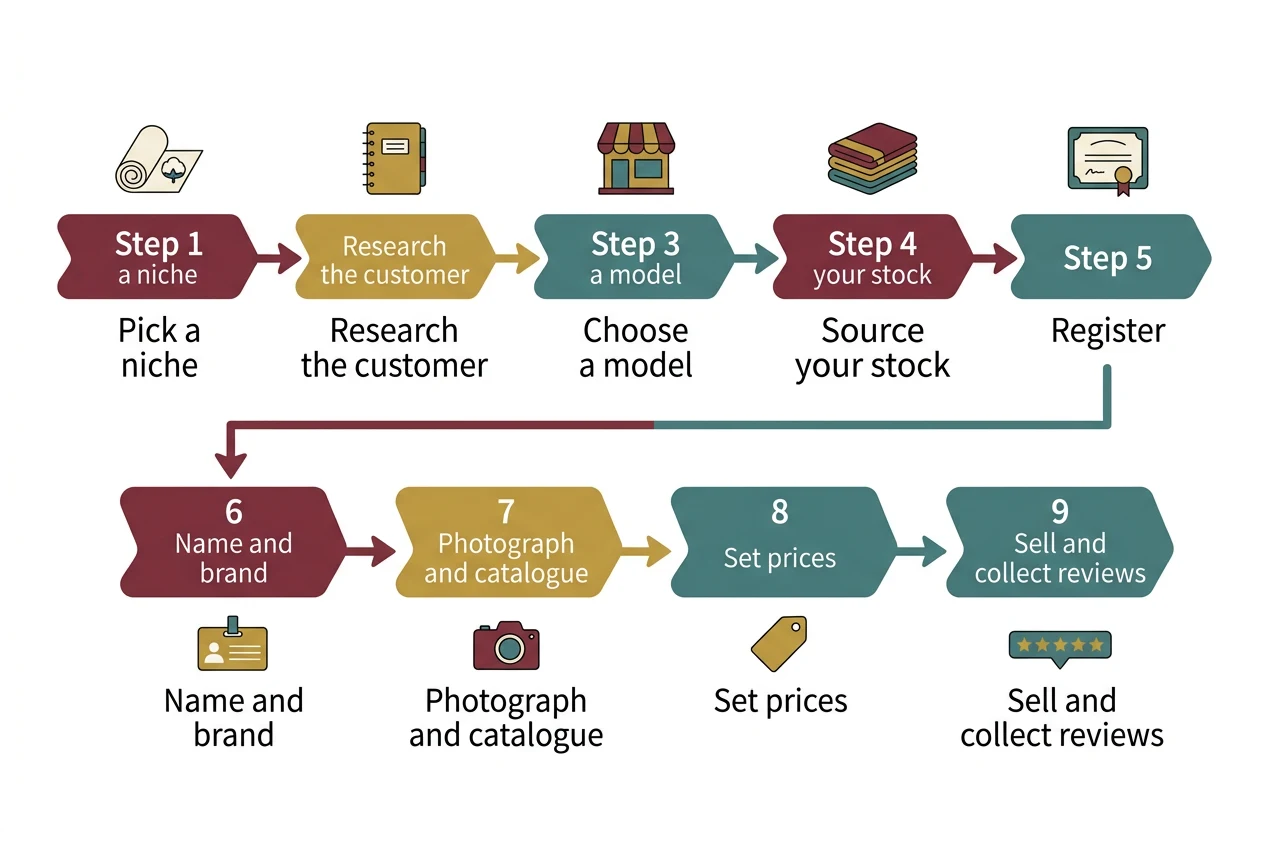
How to start a saree business: 9 steps
Here is the order I would follow. If you ask "saree business kaise shuru kare", the answer is the same nine steps: pehle niche chuniye, phir customer samjhiye, phir stock kharidiye. And for readers asking "saree business eppadi seivathu": the steps do not change by language, only the customer does.
- Pick a niche. Cotton for daily wear, silk for weddings, linen for offices, or designer for parties. One niche in the first three months beats five.
- Research the customer. Ask ten women what they last bought, what they paid and what they wish they had found. Note colours and price points.
- Choose a model. Home reselling, an online store or a shop, using the three plans above.
- Source your stock. Wholesale hubs such as Surat, Varanasi and Bhagalpur are where many sarees are made, but a trader in your own city may suit a first order better. Ask for a small first lot, and ask whether designs can be mixed in a box. Check whether a trader sells powerloom or handloom, and have it in writing.
- Register. Udyam is free and takes minutes. Get GST once you sell on Flipkart or Amazon, ship across states or cross the threshold. Sarees carry 5% GST.
- Name and brand. Pick a short name that you can say on the phone, and use the same one on WhatsApp, Instagram and your packaging.
- Photograph and catalogue. Daylight, plain background, one flat shot, one draped shot, one close-up of the border. Write the fabric, length and price in every caption.
- Set prices. Add 30 to 50% on cost, then test one price band against the next. Do not copy the lowest seller on Meesho.
- Sell and collect reviews. Ask every buyer for a photo and a line of feedback, and post them. Reviews do more than ads at the start.
Where to sell: shop vs Instagram vs WhatsApp vs Meesho vs Flipkart vs Amazon
How does a saree business work online? You choose the channel that matches your stock, your time and how much you can lose on returns. Fees below are what each channel charges as I understand them in October 2026, so check the platform's own page before you commit.
| Channel | Fees and commission | Return risk | How soon sales start | Best for |
|---|---|---|---|---|
| None (Business app is free) | Low, buyers know you | Days, from people you know | Plan A, repeat buyers | |
| No commission, ad spend and a payment gateway fee | Medium | 3 to 6 weeks to build trust | Designer, cotton silk, linen | |
| Meesho | 0% commission advertised, shipping deducted, return freight on you | High | Days after listing | Low-price cotton and printed |
| Flipkart | Commission, fixed and collection fees by price band, GST needed | Medium to high | 1 to 2 weeks after approval | Mid-range, brand building |
| Amazon | Referral and closing fees by category, GST needed | Medium | 1 to 2 weeks after approval | Higher-priced, trusted listings |
| Shop | Rent, staff, power | Low (customers try before buying) | Slow, 4 to 6 months to steady | Silk, bridal, local trust |
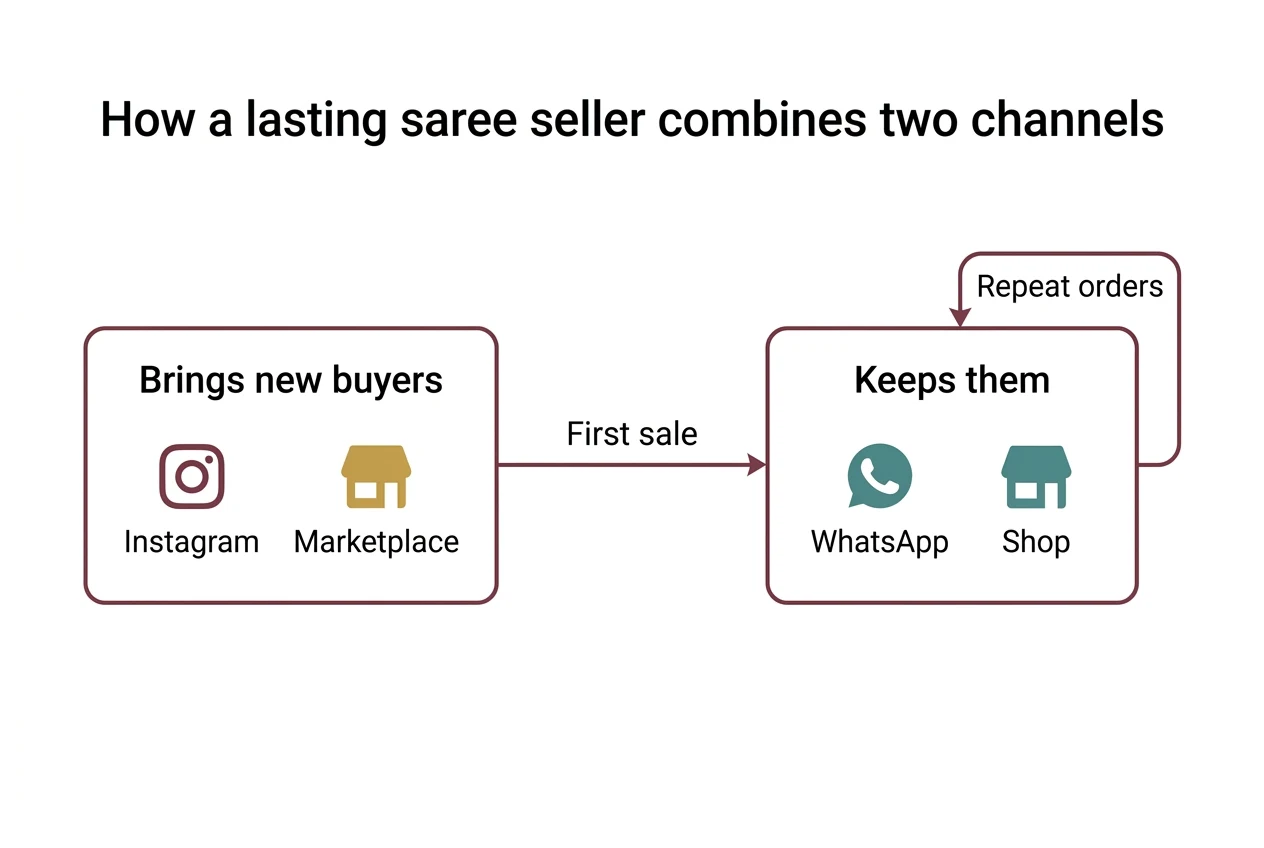
Most sellers that last use two channels: one that brings new buyers (Instagram or a marketplace) and one that keeps them (WhatsApp or a shop).
Pricing strategy and marketing tips that actually move sarees
Mark up by fabric, not by habit. Use 40 to 50% on cotton printed, 30 to 40% on cotton silk and linen, and 25 to 30% on silk. Round to a clean number, such as ₹949 or ₹1,199.
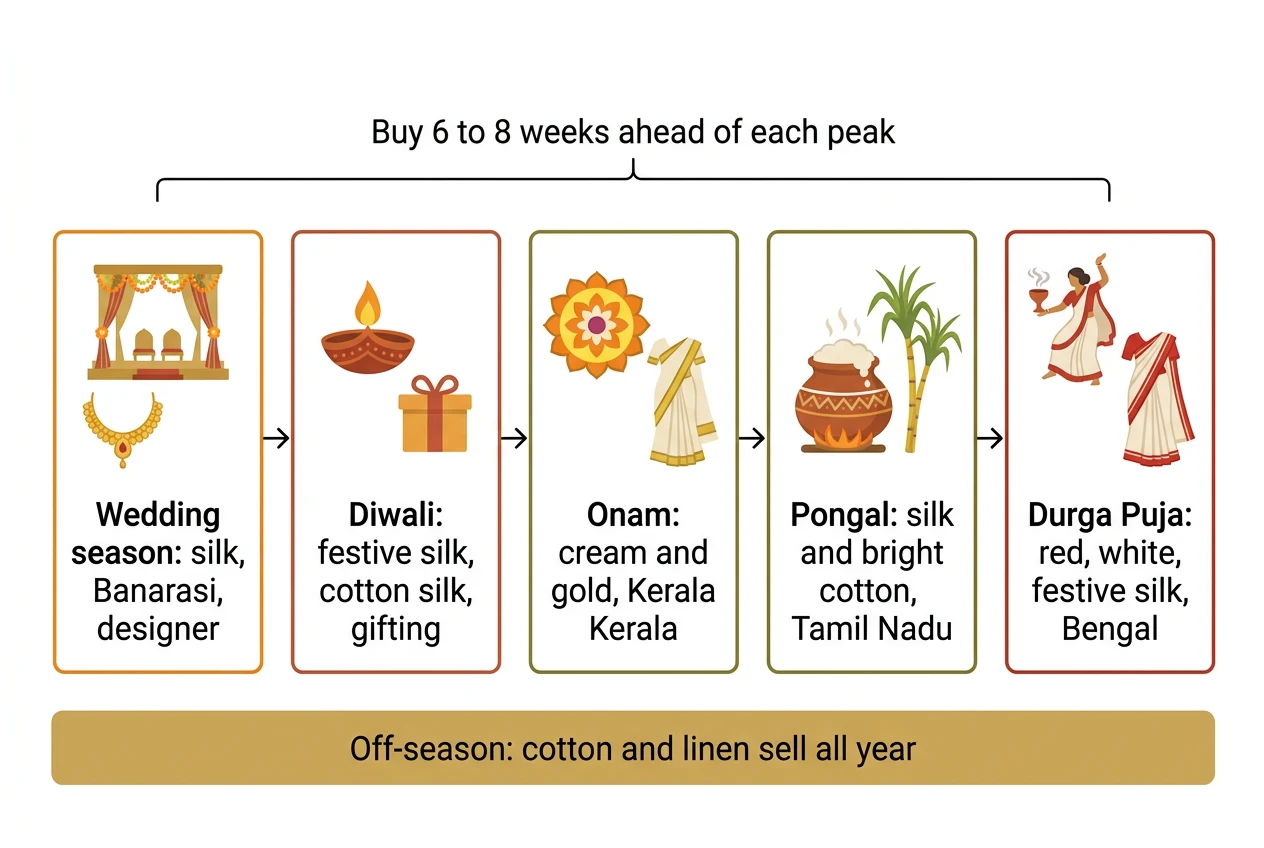
Plan stock around the calendar. Buy 6 to 8 weeks ahead of each peak:
- Wedding season: silk, Banarasi and designer, with the biggest rush before the main wedding months in your region.
- Diwali: festive silk, cotton silk and bright designer pieces, plus gifting.
- Onam: cream and gold sarees, mostly in Kerala.
- Pongal: silk and bright cotton in Tamil Nadu.
- Durga Puja: red, white and festive silk, mainly in Bengal and the East.
- Off-season: cotton and linen, which are lower in price but sell all year.
Sell with video. A 20-second reel of one saree unfolding does more than ten photos. Try a live sale once a week with six pieces and a clear price on each.
Keep your buyers. Send a WhatsApp broadcast every week or two, with three new pieces and one line of styling. Ask for a review after every order, and keep a template ready so it takes seconds. A customer who has bought twice is the cheapest sale you will ever make.
Improve what you already have. Look at which three sarees sold fastest and which three never moved. Reorder the first, and mark down the second early, before they become dead stock.
7 mistakes that kill new saree businesses
Is the saree business good or bad? Neither. It is a business with specific ways to fail, and most are avoidable.
- Buying trend-driven designs in depth. A viral colour fades in six weeks. Buy two or three of a trend, and six or more of an everyday colour.
- Ignoring returns. If you do not count returns in your price, your real margin is smaller than you think.
- Too many SKUs. Eighty designs, one of each, means no design has a chance to sell. Hold fewer designs in more depth.
- Underpricing. Matching the lowest seller on Meesho is a race you cannot win. Price for your cost plus your time.
- No GST when you need it. Selling on a marketplace or across states without registration can lead to penalties and a blocked account.
- Buying from one supplier. One supplier raising prices, or running late before a festival, can stop your whole business. Keep two or three.
- Ignoring the off-season. Sellers who buy only for weddings and festivals have nothing to sell for five months. Keep a base of cotton and linen that sells all year.
Saree business ideas if you want a different model
Not every saree business has to be reselling. Here are the other ways in:
- Reselling: buy from a trader and sell on WhatsApp, with no shop or website.
- Handloom direct from weavers: a better story and a better saree, but it needs a trusted weaver and a longer wait.
- Rental: you rent out bridal and party sarees for a day. It needs more stock and a cleaning routine.
- Pre-stitched sarees: a ready-to-wear drape for buyers who avoid pleating.
- Blouse add-ons: stitched blouses, fall and pico, and petticoats, which add margin to every sale.
- Manufacturing: setting up looms or hiring weavers. The saree manufacturing business cost starts in the lakhs and goes far beyond a first-time seller's budget, so treat it as a later step.
If you have to choose one best saree business in India, choose the one that matches your cash, your time and your town. For most beginners that is cotton and cotton silk reselling online, with a small silk shelf added after the first few months.
FAQ
Is saree business profitable in India?
Yes. IMARC puts the market at USD 6.15 billion in 2025, and a well-run seller earns a gross margin of 25 to 45% depending on fabric. It stays profitable only if you keep returns low, avoid dead stock and control ad spend. The business is rarely lost on demand. It is lost on stock.
How much investment is needed to start a saree business?
You can start with about ₹25,000 at home, ₹1 lakh for a proper online business and ₹5 lakh or more for a shop. Stock is the largest part of each plan. Keep a buffer of 15 to 20% of your budget for returns and reorders, which is the item most beginners skip.
What is the profit margin in saree business?
Gross margin is about 35 to 45% on cotton printed and designer sarees, 30 to 40% on cotton silk and linen, and 25 to 30% on Kanjivaram and soft silk. Net profit is lower after shipping, packaging, returns and ads. In the worked month above, net profit was about 24% of sales.
How can I start a saree business at home with low investment?
Buy 20 to 30 cotton and printed sarees for about ₹16,000, photograph them in daylight and list them in a WhatsApp Business catalogue with prices. Post reels on Instagram and send a weekly broadcast to everyone who has messaged you. Reinvest your first profit in the designs that sold fastest.
How much can I earn per month from a saree business?
A home seller can expect about ₹3,000 to ₹6,000 a month at the start. An online seller with ₹1 lakh of stock can earn about ₹13,000 to ₹15,000, as in the worked month. A shop can reach ₹25,000 to ₹45,000 after rent and staff, once footfall builds.
Do I need GST registration to sell sarees online?
On Flipkart and Amazon, yes. Elsewhere it depends on where you sell and your turnover. An exemption exists for small sellers who sell only within their own state through marketplaces and stay below ₹40 lakh, but it has conditions. Confirm your case on the GST portal or with a CA before you list.
Which sarees sell the most for beginners?
Cotton and cotton silk sarees sell the most for beginners. Cotton is 23% of the Indian saree market, the price is low and customers buy it all year. Add linen for office wear and a few designer pieces for parties. Wait to stock silk until you have seen what your own customers ask for.
Is selling sarees on Instagram or Meesho better for beginners?
Start on Instagram and WhatsApp if you want control over price and a repeat customer. Choose Meesho if you want sales in days and can live with thin prices and higher returns. Many sellers use both: Meesho for fast-moving cotton and Instagram for designer and silk pieces.
How silksaree.shop can help you start
silksaree.shop is the trade name of Kenche Mallikarjuna Handlooms, a saree house in Rayadurg, on the Andhra Pradesh and Karnataka border. The family has worked in the saree trade for over 100 years. They sell designer silk sarees wholesale to saree shops, boutiques and resellers across India, direct from the maker.
Here is what that means for the two readers this guide is written for.
If you run a small clothing shop and want to add sarees. A first saree shelf is hard to fill from scratch. Sarees here come in boxed sets of 28, and one set is the minimum order, so a single order can fill a shelf with a matching range. It also answers the "too many SKUs" mistake above, because a set gives you depth in a few designs. Most of the sarees are woven on power looms and some on handlooms. Ask which is which before you order, as step 4 says.
If you are a woman starting from home. Be clear about the size of the step. A set of 28 is a wholesale order, so it suits you once you have buyers waiting, or when you and two or three others share one set and split it. That sharing is a suggestion from me, not an arrangement the supplier offers, so settle it among yourselves first. If you are still at Plan A, start with a small cotton lot from a trader near you, and come back to a full set when your WhatsApp list is ready for silk.
If you want your own design. They also weave to order in your colours, border and motif. For a reseller, that is a way to sell something your customers cannot find in the next shop. Have a photo, your colours and your border ready before you message, and ask about quantity and timing on WhatsApp.
How to ask. Kenche Ramesh answers enquiries himself on WhatsApp, on +91 94409 21080, and also on Instagram at @kencheramesh. Send your town, how many sets you want, and the colours or weaves your customers ask for. He replies with prices, and payment is agreed on WhatsApp. Prices are not on the site, so ask for a quote and compare it with your other suppliers, as the mistakes list advises.
What to do next
Pick the plan that fits your cash, and write down its table with your own prices before you spend anything. Then ask three suppliers for the same ten sarees and compare their quotes, and include one set quote from silksaree.shop if you are ready to stock silk.