
How to Get a Small Business Loan: Scheme or Bank?
14 October 2026 · silksaree.shop · 7 min read
తెలుగులో చదవండిGoogle Translate
In short: How to get a small business loan: a small shop or first business usually starts with a MUDRA loan from a bank. An older business with records can ask for a regular bank loan. Keep a one-page proposal ready.
Wondering how to get a small business loan? Start with one choice: a government scheme or a plain bank loan. This post helps you pick, tells you what lenders ask for, and shows a sample proposal you can copy.
We'll keep it simple. And a promise: we won't tell you to borrow before you know your business works.
Scheme or bank loan: which one?
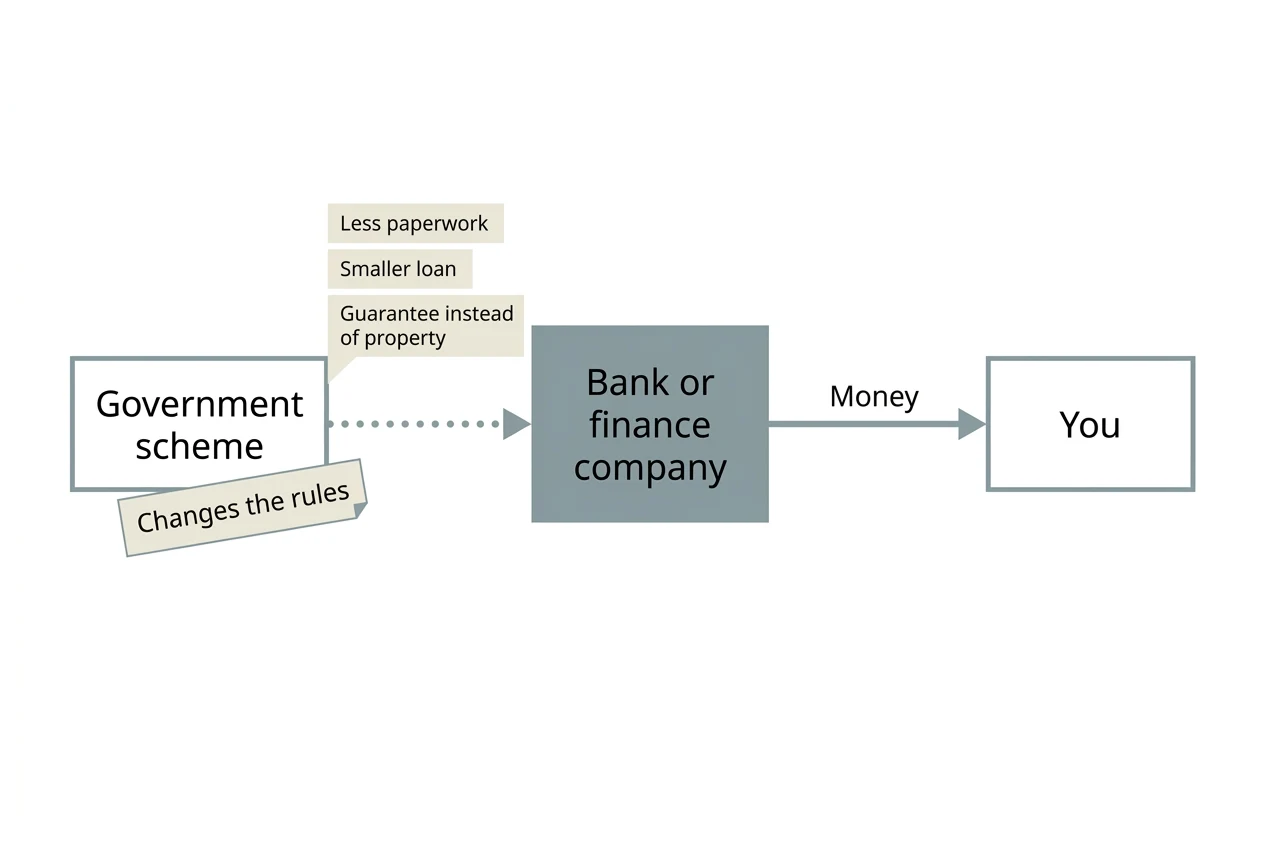
Most people miss this. A government scheme is not a separate lender. Your money still comes from a bank or a finance company, and the scheme only changes the rules: less paperwork, a smaller loan, sometimes a subsidy, sometimes a government guarantee in place of your property.
So the real question is which door suits you. Here's a quick map.
| Your situation | Try this first | Why |
|---|---|---|
| Starting a small shop or reselling goods | MUDRA loan | Built for small non-farm businesses, including shopkeepers and traders |
| Making a product (food, stitching, a small unit) | PMEGP | Gives a subsidy on new units, but only if you make something |
| A woman, or SC/ST, starting a new business | Stand-Up India | Bank loans from ₹10 lakh to ₹1 crore for a new enterprise |
| Running for some years, with bank statements and returns | Regular bank loan | Lenders can see your history, so you can ask for more |
| Need a loan but have no property to pledge | Ask the bank about CGTMSE cover | The scheme guarantees the loan so you needn't pledge security |
Not sure where you fit? You probably aren't alone, and that's what the bank manager is for. More on that below.
The schemes, in plain words
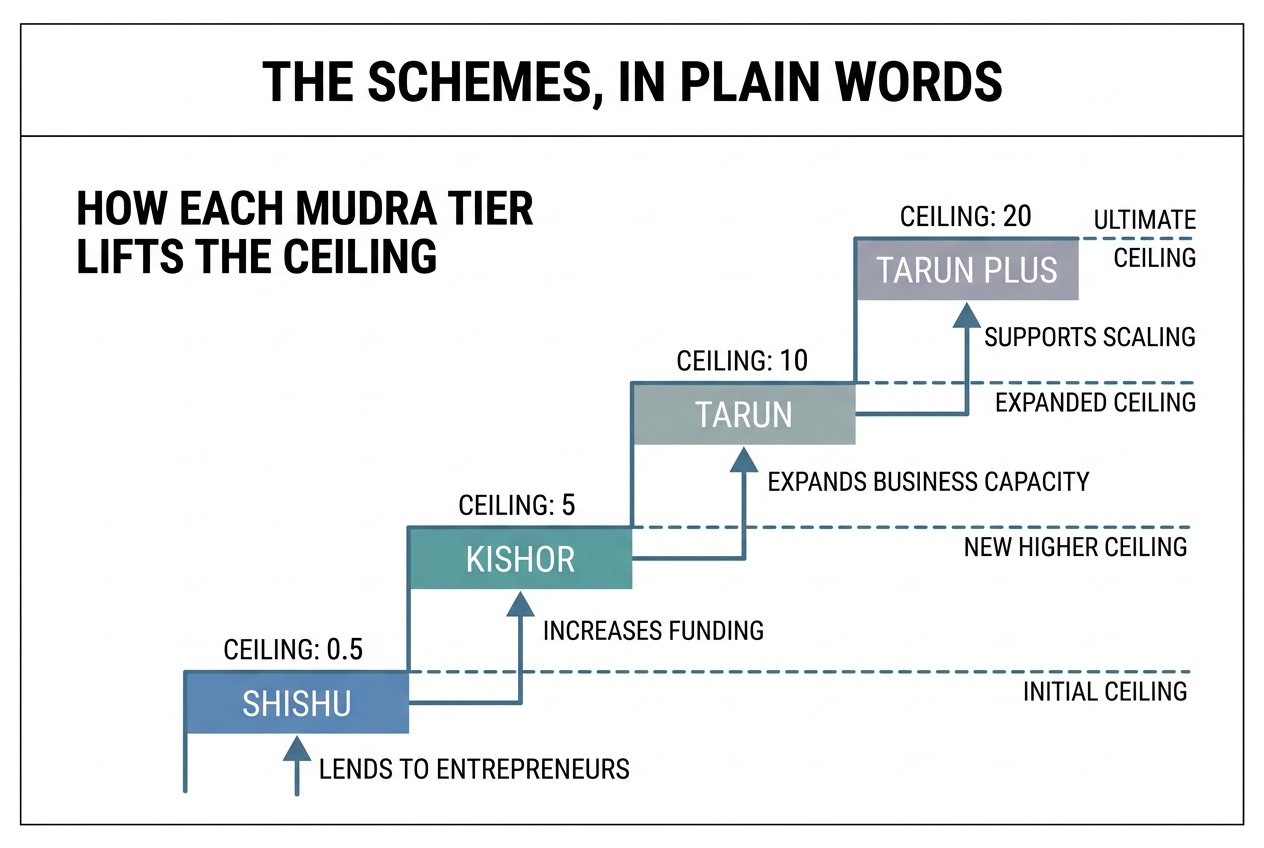
MUDRA. For small non-farm businesses. There are four tiers: Shishu up to ₹50,000, Kishor up to ₹5 lakh, Tarun up to ₹10 lakh, and Tarun Plus up to ₹20 lakh. Tarun Plus is for people who already repaid a Tarun loan. SMFG India Credit lists them, and says you don't need to pledge collateral. You apply at a participating bank or on Udyamimitra.
PMEGP. A subsidy for new units. The usual split is 10% your own money for a general applicant, 5% for special categories. The subsidy is 15% in towns and 25% in villages for general applicants, and 25% and 35% for special categories. Plain buying and selling is mostly off the list. Retail outlets are allowed nationwide only when they sell certain khadi and village-industry products, so check before you plan around it.
Stand-Up India. Bank loans between ₹10 lakh and ₹1 crore for a new enterprise owned by a woman or an SC/ST entrepreneur.
CGTMSE. A guarantee, not a lender. CGTMSE says it covers collateral-free and third-party-guarantee-free loans that lenders give to micro and small enterprises.
The RBI rule. Since 1 April 2026, banks may not take collateral on loans up to ₹20 lakh to micro and small enterprises. So even a regular bank loan can be collateral-free at this size. Ask your bank how it applies the rule.
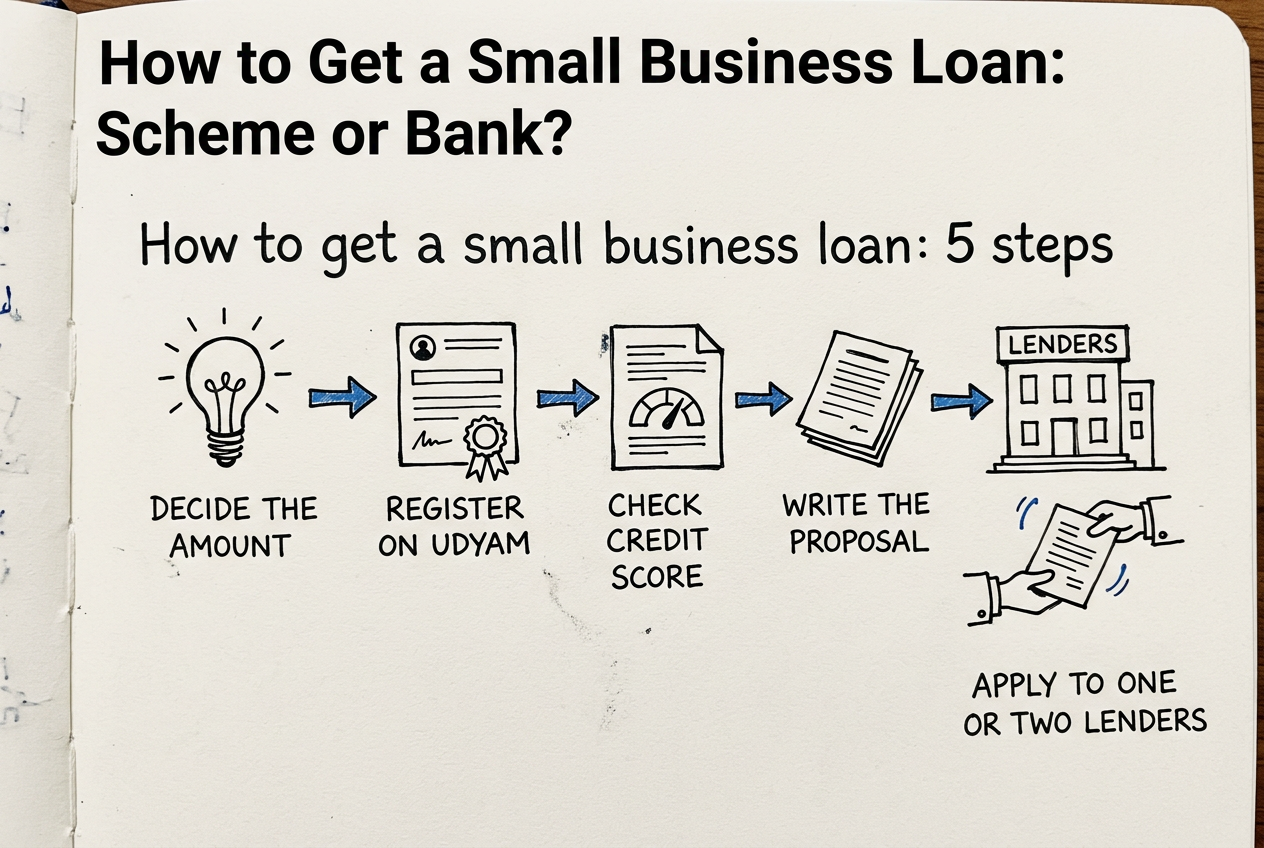
How to get a small business loan: 5 steps
- Decide the amount and what it buys. Stock, a machine, a shop fit-out. Add up real quotes, not guesses.
- Register on Udyam. It's the government's free registration for small businesses. Register here and pay no one for it.
- Check your credit score. Lenders look at it, and for a young business they look at yours, personally. Clear small dues first.
- Write the one-page proposal. A sample is below.
- Apply to one or two lenders. Start with the bank where you already hold an account. Many applications at once leave marks on your credit report.
Got a "no"? Ask why, fix that one thing, and try a different type of lender.
What lenders ask for
Every lender has its own list, so ask for theirs. These are the papers named most often:
- Photo ID and address proof (PAN, Aadhaar)
- Proof the business exists: Udyam certificate, GST registration or a shop licence
- Last six months of bank statements
- Income tax returns or financial statements, if you have them
- The loan proposal, with your plan
- A quote from your supplier for what the loan will buy
No returns yet? You can still apply. Bring savings, clean bank statements and that supplier quote.
Official documents worth opening
Read these yourself instead of trusting anyone's summary, ours included. They change, and the official page always wins. We tried to show them right here on the page, but the government sites don't allow it, so each opens on its own site.
- RBI press release on the ₹20 lakh collateral-free limit
- MUDRA loan application forms (official site)
- Udyamimitra portal to apply online
- PMEGP portal run by KVIC
- CGTMSE guarantee scheme
- Stand-Up India
A sample proposal to submit
Banks like it short. Here's how a one-page proposal can look. Copy it into a document, replace everything in brackets, and keep it honest.
LOAN PROPOSAL

Applicant:        [Your name], [PAN]
Business:         [Name], [shop / unit], [address]
Registration:     Udyam No. [number]   GST: [number or "not applicable"]
Running since:    [date, or "new business"]

1. What I do
   [Two lines. What you sell, to whom, where.]

2. Loan asked
   Amount:        Rs [amount]
   Purpose:       [Stock / equipment / fit-out]
   Scheme:        [MUDRA Kishor / Regular loan / Other]
   Repayment:     [months] months

3. How the money will be used
   [Item]          Rs [amount]    (supplier quote attached)
   [Item]          Rs [amount]
   Total           Rs [amount]
   My own money    Rs [amount]
   Loan needed     Rs [amount]

4. How I will repay
   Expected monthly sales:   Rs [amount]
   Monthly costs:            Rs [amount]
   Left for the EMI:         Rs [amount]
   [One line on how you got these numbers, such as a trial run.]

5. Attached
   ID and address proof, Udyam certificate, bank statements
   (6 months), supplier quote, [returns if any]

Signature / Date
Section 4 is the one that decides things. If a banker can see how the loan pays itself back, the rest is paperwork.
Starting a saree business? Test first
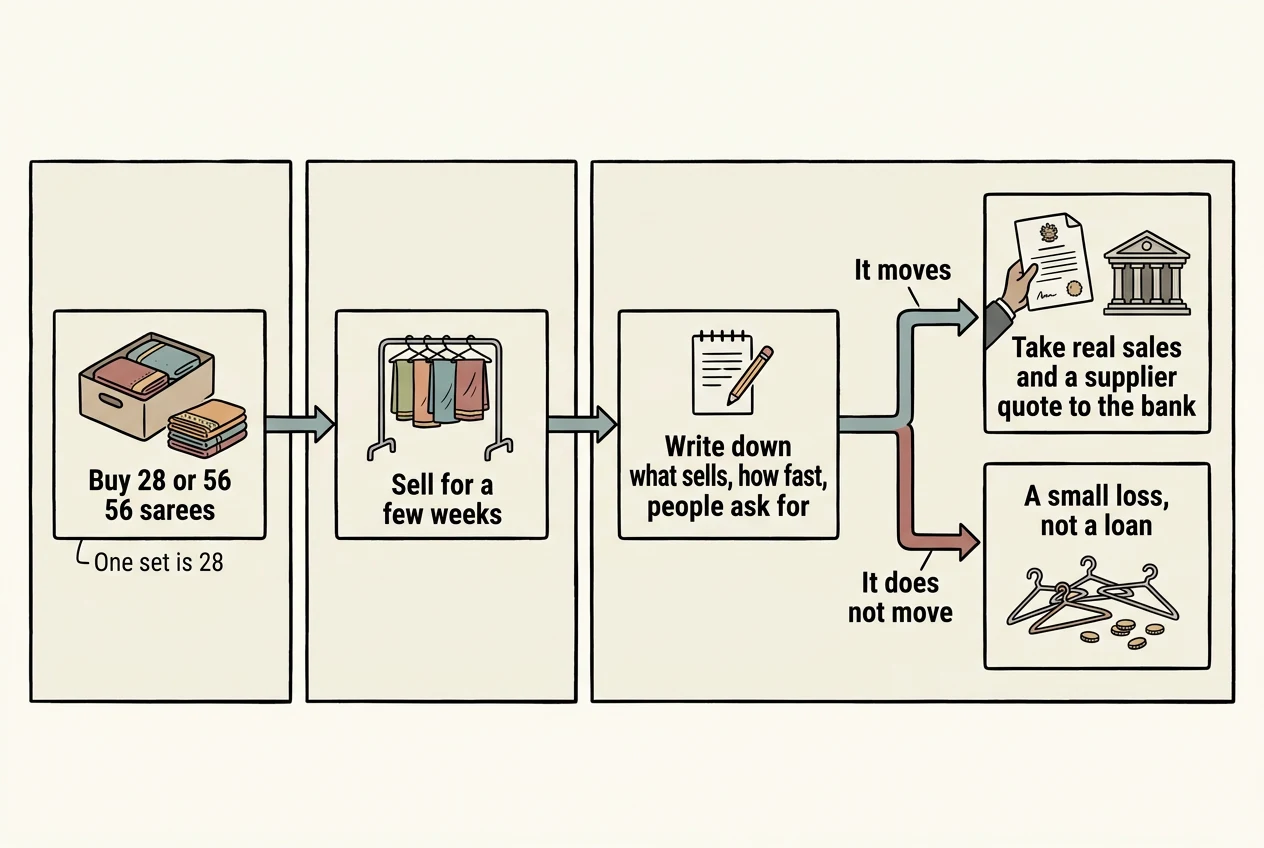
If you want to sell clothing, don't borrow on day one. Test the market first, with a small buy.
Buy 28 or 56 sarees from silksaree.shop, which is Kenche Mallikarjuna's saree house in Rayadurg. A set is 28 sarees and one set is the minimum order, so 56 is two sets. Prices are agreed on WhatsApp (+91 94409 21080).
Then sell them for a few weeks. Write down what sells, how fast, and what people ask for. If it moves, you have something a bank can read: real sales, a real supplier quote and a clear plan. That's the proposal above, with section 4 filled in from facts. If it doesn't move, you've lost a small amount, not a loan.
Our guide to starting a saree business works through the costs line by line.
Talk to people before you sign anything
We're a saree house, not your adviser. Rules, limits and forms change, and no blog post knows your papers. Before you apply, talk to:
- Your bank's branch manager. Ask which schemes the branch handles and what it needs from a business your age.
- The District Industries Centre in your district, for scheme help.
- A chartered accountant if your accounts are messy.
For a longer step-by-step with timelines, see our 7-step small business loan guide.
What to do next
Write the amount and what it buys. Register on Udyam this week. Then, if it's sarees, order your first 28 and see what happens.