
How to Get a Small Business Loan in India: 7 Steps
11 October 2026 · silksaree.shop · 11 min read
తెలుగులో చదవండిGoogle Translate
In short: To get a small business loan in India, fix the amount and purpose, check your credit score, register on Udyam, gather your papers, then apply to a bank, an NBFC or a scheme such as MUDRA.
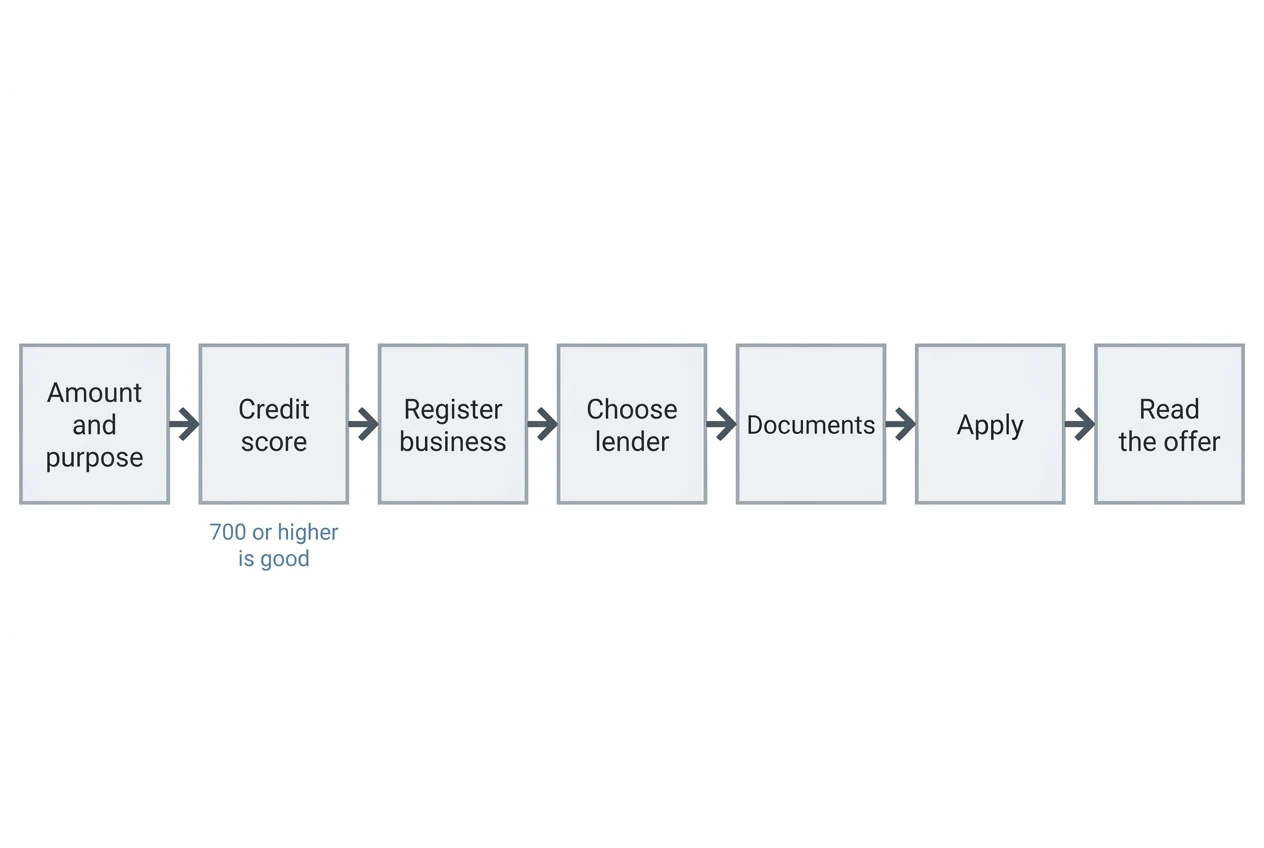
How to get a small business loan in India comes down to seven steps: decide what the money is for, check your credit score, register the business, collect your papers and apply to a bank, an NBFC or a government-backed scheme. Each step below has the papers it needs and the time it can take.
Most guides stop at "compare lenders and apply". They rarely say how long you will wait, what a first-time borrower should do with no business history, or what to do after a "no". This one covers those. Figures come from the lenders and official pages named in the text, and I say where I could not confirm one. Rates and limits change, so check the lender's own page before you apply.
Last updated: 10 October 2026. Written by: the silksaree.shop team.
Which loan do you need?
Start with what the money does. The answer decides which lender will even look at you.
- Working capital. Day-to-day cash: stock, wages, rent. A shop that buys saree stock before a festival needs this.
- Term loan. A fixed sum for something that lasts, such as a machine or a fit-out, repaid over a set period. CRIF High Mark describes term loans as running one to five years.
- Equipment loan. A term loan tied to one asset, which usually stands as the security.
- Start-up loan. Money for a business that has not traded yet. This is the hardest to get from a bank, which is why the section on new businesses is further down.
Write down the amount, what it buys and how the business will repay it each month. If you cannot say how the loan repays itself, the lender will notice.
How to get a small business loan: 7 steps
- Fix the amount and the purpose. Ask for what the plan needs, not the largest figure a lender will allow. Add a small buffer for the first slow month.
- Check your credit score and fix errors. CRIF says 700 or higher is considered good, and that for a business under three years old the lender also looks at your personal credit history. Pay small dues, close what you do not use and ask the bureau to correct mistakes before you apply, because every application leaves a mark on your report.
- Register the business. Udyam registration is the government's free registration for micro, small and medium businesses. Lenders and scheme portals often ask for it. Add GST if your sales need it.
- Choose the type of lender. Banks, NBFCs, cooperative banks and government-backed schemes each suit a different borrower. The next section compares them.
- Gather your documents. The checklist below lists what most lenders ask for. Collect it first, and a request for "one more paper" will not cost you a week.
- Apply. Apply at a branch, on the lender's website or through the Udyamimitra portal, which says it lets you check eligibility, apply online, get approval from a chosen bank and track the application. Apply to one or two lenders at a time, not ten.
- Read the offer before you accept. Look at the interest rate, the processing fee, the repayment period, the charge for paying early and whether the lender wants security or a guarantor. If something is unclear, ask for it in writing.
Where to borrow: banks, NBFCs and schemes
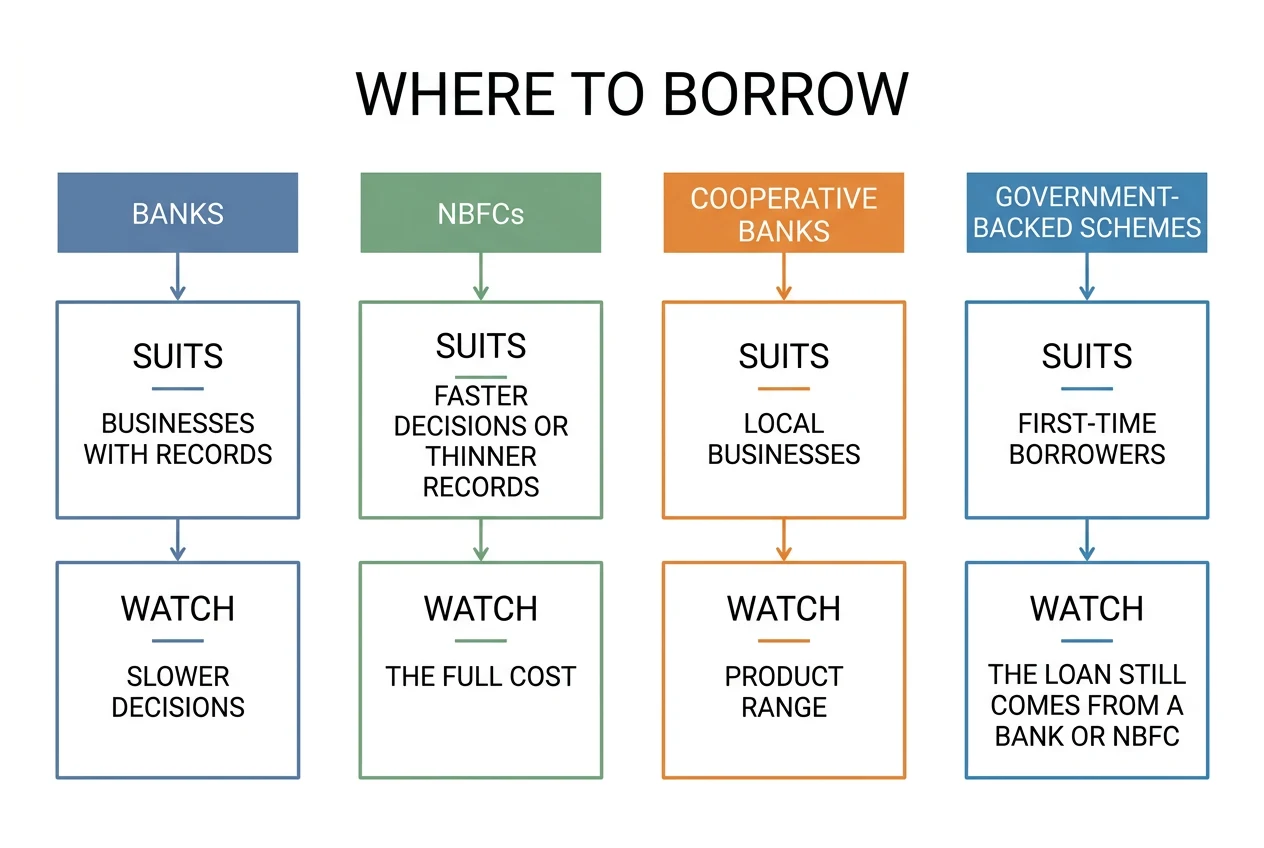
Shriram Finance lists four routes: traditional banks, NBFCs (non-banking finance companies), government schemes and local cooperative banks. Here is how they differ.
| Route | Usually suits | Watch for |
|---|---|---|
| Public and private banks | Businesses with records and a bank account history | Slower decisions, more paperwork |
| NBFCs | Borrowers who need a faster decision or have thinner records | Check the full cost, not only the headline rate |
| Cooperative banks | Local businesses with a local relationship | Product range varies |
| Government-backed schemes | First-time and small borrowers | The loan still comes from a bank or NBFC |
One search result for new businesses said NBFCs are often the easier door, because many banks prefer to lend to firms that already trade. Treat that as a pattern, not a rule, and ask each lender what it needs from a business of your age.
Your own bank is a good first call. CRIF suggests going to your existing bank first, since it already holds your information.
Documents to keep ready
Lists differ by lender, so ask for theirs. These are the papers named most often in the lender pages I read.
- Identity and address proof: PAN, Aadhaar or another government photo ID, and a current address proof.
- Proof the business exists: Udyam certificate, GST registration, trade licence or shop licence.
- Bank statements: one MUDRA guide names the last six months, and lenders often ask for the same.
- Income records: income tax returns and financial statements, which larger lenders ask for more strictly.
- A short business plan: what you sell, who buys, what the loan buys and how you repay it.
- For companies and partnerships: the partnership deed or incorporation papers, plus the directors' documents. Kogta lists these.
A new business with no returns can still apply. Bring your savings and bank statements, a clear plan and any order or supplier quote that shows the money has a job.
How long does it take?
This is the part most guides leave out, and no official source I found gives one number that applies to every loan. What I could confirm is below.
| Stage | What I found | Source |
|---|---|---|
| Preparing the papers | Depends on you. A few days if the records exist, longer if returns or registration are missing | My estimate |
| Online lender decision | One NBFC says money is credited within 48 hours of application, subject to checks | Bajaj Finserv, the lender's own claim |
| PSB Loans in 59 Minutes portal | In-principle approval in 59 minutes, then final sanction and disbursal by the chosen bank | Paisabazaar and a DMI Finance FAQ |
| Bank or scheme loan | I found no published timeline. Ask the branch for its credit decision timeline | None |
The Bajaj, Paisabazaar and DMI pages would not open for me, so those two timings come from search summaries of them. Check them on the lender's own page.
Treat "in-principle" as a yes-subject-to-checks, not money in your account. Budget weeks, not days, for a bank or scheme loan, and keep one month of expenses clear in case the money arrives late. That is my advice, not a lender's promise.
Government schemes that can help
This is a short map. A full guide to each scheme will come separately. Limits and rules change, so confirm them on the scheme's official page before you apply.
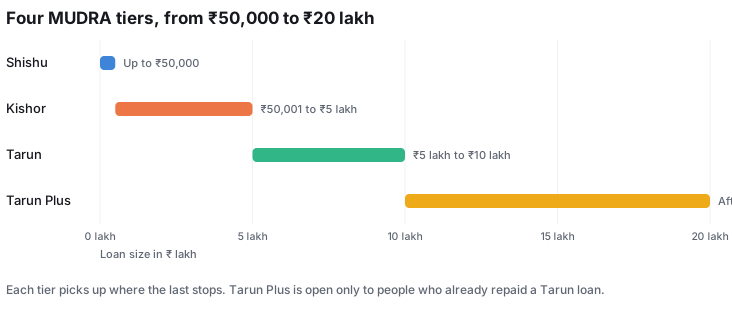
- MUDRA (PMMY). For small non-farm businesses. SMFG India Credit lists four tiers: Shishu up to ₹50,000, Kishor from ₹50,001 to ₹5 lakh, Tarun from ₹5 lakh to ₹10 lakh and Tarun Plus from ₹10 lakh to ₹20 lakh. Tarun Plus is for people who already repaid a Tarun loan. You apply through a participating lender or on Udyamimitra.
- Stand-Up India. Bank loans between ₹10 lakh and ₹1 crore for a new, greenfield enterprise owned by a woman or an SC/ST entrepreneur above 18. For a company, at least 51% of the shareholding and control must sit with such an entrepreneur.
- CGTMSE. A guarantee scheme, not a lender. CGTMSE says it guarantees loans that banks and other lenders give micro and small enterprises without collateral or a third-party guarantee, and that its guarantee ceiling is now ₹10 crore.
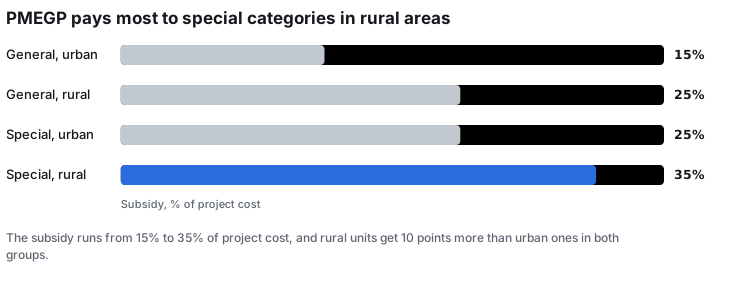
- PMEGP. A subsidy for new units, run by KVIC. SBI's product page gives the subsidy for a general-category applicant as 15% in urban areas and 25% in rural, and for special categories as 25% urban and 35% rural. The cap on project cost differs between sources, so check KVIC before you plan around it.
- The new RBI rule on collateral. RBI circular RBI/2025-26/206, dated 9 February 2026, bars banks from taking collateral on loans of up to ₹20 lakh to micro and small enterprises, for loans sanctioned or renewed from 1 April 2026. Taxmann's summary says banks may go to ₹25 lakh for units with a good track record. I did not open the circular itself, so ask your bank how it applies the rule to you.
Not every business qualifies for every scheme, and a scheme only widens the door. The bank or NBFC still decides.
If your business is new
A bank sees a new business as a risk because there are no returns to read. You can still improve your odds.
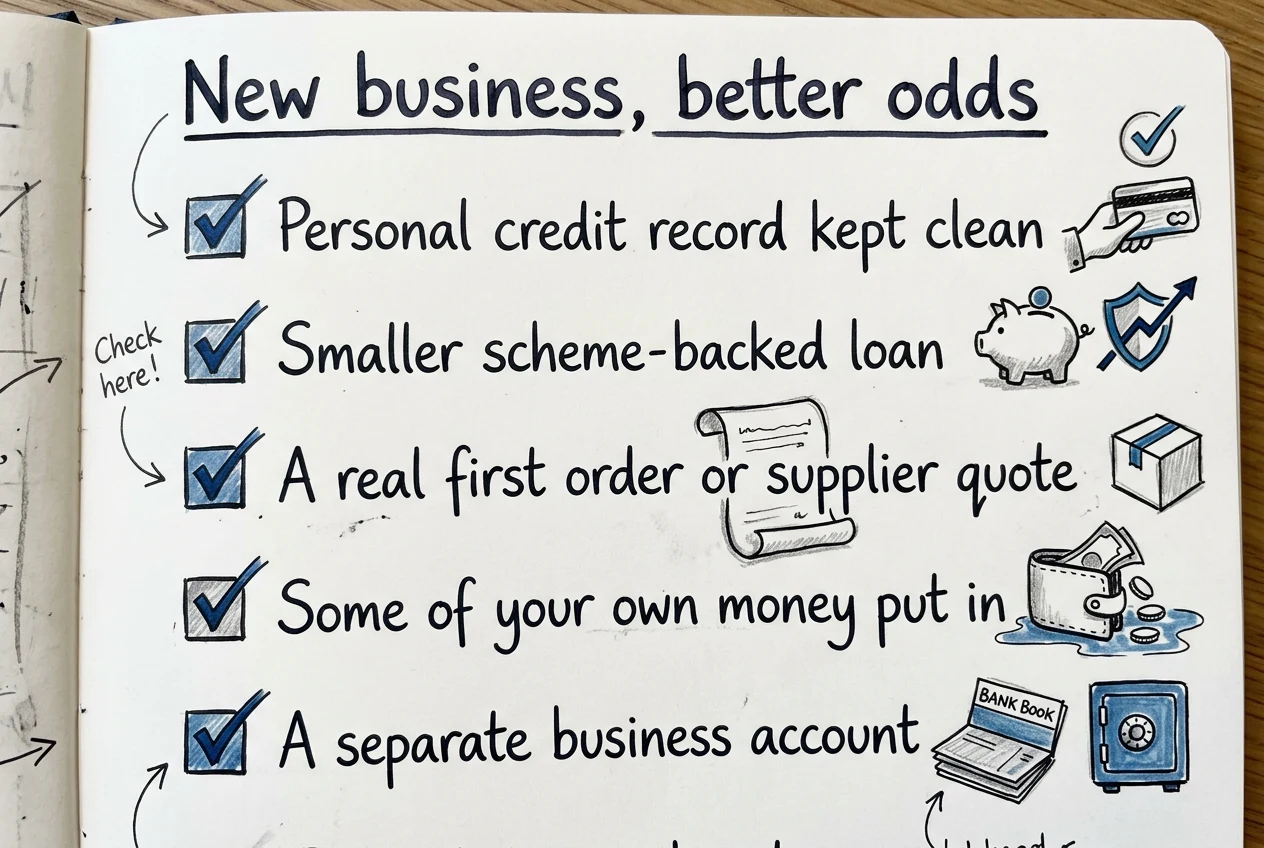
- Use your personal record. For a young business, the lender looks at your personal credit history, so keep it clean.
- Start with a smaller, scheme-backed loan. Shishu and Kishor MUDRA loans, or a PMEGP project, are built for first-time borrowers.
- Show a real first order. A supplier quote, a signed order or a month of sales messages tells a lender the plan has a buyer.
- Put in some of your own money. PMEGP asks for an own contribution, and lenders generally like to see you share the risk.
- Keep a separate business account. Clean statements are the only history a new business has.
If you are still choosing what to start, our list of small business ideas in India sorts 15 by what each needs. If you plan to resell sarees, how to start a saree business works out three budgets, line by line, so you can ask for a number you can defend. The women's business ideas guide covers Mudra and Stand-Up India for women founders.
Why loan applications get rejected
Lenders rarely give a full reason, but these are the usual causes in the guides I read.
- A weak credit record. Late payments or unresolved dues on your report.
- Too little history. CRIF's eligibility list expects a business that has run for some years and shown profit, so a young firm may be turned down for a standard loan and sent to a scheme instead.
- Missing or mismatched papers. A name on the PAN that differs from the bank account, or a statement that is a month short.
- Asking for too much against weak sales. The amount has to fit what the business earns.
- Many applications at once. Each one is a credit enquiry.
If you are refused, ask for the reason, fix that one thing and try a different type of lender. Do not reapply to the same lender with the same file.
Borrowing to buy stock
A reseller's loan usually becomes stock, so match the loan to a real order. Direct-from-maker suppliers sell in minimum lots. silksaree.shop sells silk sarees wholesale in boxed sets of 28, with one set as the minimum order, and prices and payment are agreed on WhatsApp. Ask the supplier for a quote first, then put that quote in your loan application. Do not assume a supplier offers credit; the site says nothing about it.

FAQ
How can I get a small business loan with no collateral?
Ask a bank for a loan within the collateral-free limit. Since 1 April 2026, banks may not take collateral on loans of up to ₹20 lakh to micro and small enterprises, according to Taxmann's summary of the RBI circular. MUDRA loans and CGTMSE-guaranteed loans are also meant to be collateral-free.
What credit score do I need for a small business loan?
There is no single cut-off. CRIF says 700 or higher is considered good and improves your chances. Each lender sets its own bar, so ask what yours needs before you apply.
How long does it take to get a small business loan?
It depends on the lender. One NBFC says it credits money within 48 hours of application, and the PSB portal gives in-principle approval in 59 minutes. I found no published timeline for banks and schemes, so plan for weeks.
Can a new business get a loan?
Yes, but it is harder. Your personal credit history counts, and schemes such as MUDRA and PMEGP exist for first-time borrowers. Bring a business plan and proof of your first order.
What is the easiest small business loan to get?
There is no safe answer. Smaller loans from your own bank, or scheme-backed loans such as MUDRA Shishu or Kishor, usually ask for less history. Whether you qualify depends on your credit record and papers.
Do I need Udyam registration for a business loan?
Often, yes, and it is free. Many lenders and scheme portals ask for it as proof that the business exists. Register on the official Udyam portal and pay no one for it.
What to do next
Write down the amount, what it buys and how you repay it. Check your credit score this week, register on Udyam, and collect the six documents above in one folder. Then ask your own bank for its published decision timeline before you apply anywhere else.