
10 Business Ideas for Women in India You Can Start in 2026
9 October 2026 · silksaree.shop · 10 min read
తెలుగులో చదవండిGoogle Translate
In short: The best business ideas for women start from something you already do well, with buyers you can name. Home food, tutoring, tailoring, gifting and saree reselling are the easiest to test first.
You're probably not short of ideas. What you need to know is which one fits your day, your savings and the people around you, and who will pay you first.
This guide gives ten business ideas for women in India, each with what it needs to start and where it tends to go wrong. Then it shows how to choose one, what money support exists, and how one idea, saree reselling, works when you buy stock. No idea here comes with a promised income, because your town, your buyers and your hours decide that. Read the notes as a plan to test.
Last updated: 9 October 2026. Written by: the silksaree.shop team.
Start with the hours and money you really have
A good plan begins with two honest numbers. How many hours a week can you give this, without breaking something else? And how much can you lose without it hurting your family?
Say you have two free hours a day. A business that needs a shop open from ten to eight is the wrong pick, even if it sounds good on paper. If you have little cash, pick something where your time is the main cost. Tutoring and tailoring ask for almost no stock, and so does social media help. Anything that needs stock, such as sarees or gifts, ties up money until it sells.
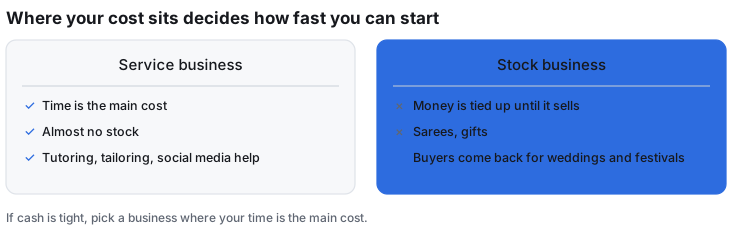
Write both numbers down before you read the list. They'll cut it from ten to three quicker than any advice.
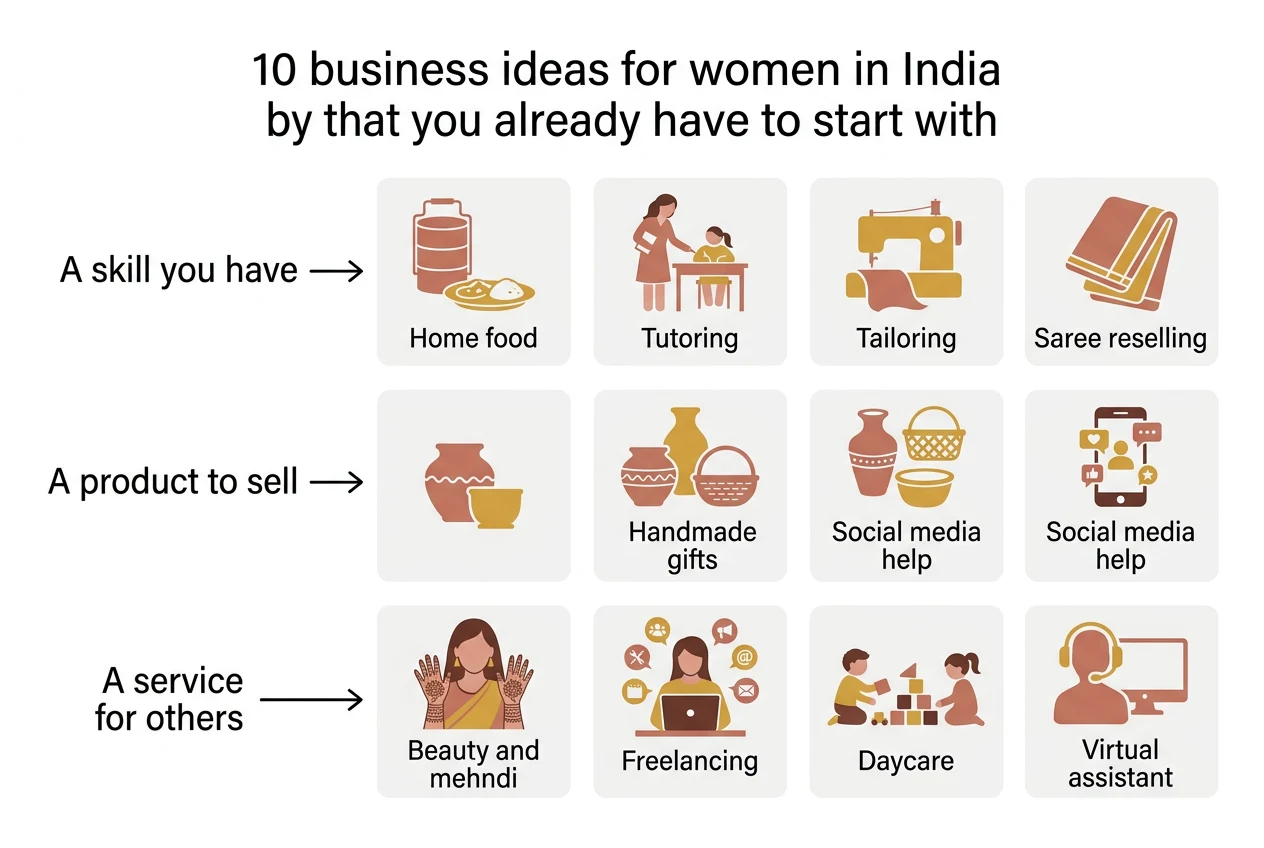
10 business ideas for women, sorted by what you already have
"Starts with" is the cheapest way to test the idea. The risks are my own reading of each model, not a survey.
| # | Idea | Starts with | Biggest risk |
|---|---|---|---|
| 1 | Home-cooked food and snacks | Neighbours and relatives | Food safety rules |
| 2 | Tutoring and coaching | One subject you know well | Steady students |
| 3 | Tailoring and blouse stitching | A machine and a few regular clients | Deadlines at festival time |
| 4 | Saree and clothing reselling | A small first lot, sold on WhatsApp | Stock that does not move |
| 5 | Handmade gifts and hampers | Photos and a few samples | Slow custom work |
| 6 | Social media help for local shops | Two or three shops you know | Proving results |
| 7 | Beauty and mehndi services | A small kit and a portfolio | Irregular bookings |
| 8 | Freelance writing, design or editing | Two or three sample pieces | Slow first client |
| 9 | Daycare or activity classes | A safe room and parent trust | Rules and insurance |
| 10 | Virtual assistant work | Email, forms and spreadsheets | Low pay at first |
1. Home-cooked food and snacks
Pickles, podis, laddus and tiffin meals keep well or travel well. Take orders on WhatsApp and cook in small batches. Food needs the right registration, so ask your local food safety office what applies before you sell.
2. Tutoring and coaching
If you know a subject, you can teach it at home or on a video call. Start with two or three students you already know. The cost is your time, and word of mouth fills your batches.
3. Tailoring and blouse stitching
Women who stitch well are never short of work around weddings and festivals. Begin with people who already trust your work. The trap is saying yes to every deadline in the same week, so decide how many pieces you can finish before you quote a date.
4. Saree and clothing reselling
You buy from a maker or wholesaler and sell on WhatsApp, Instagram or in your neighbourhood. Sarees are light to ship, and buyers come back for weddings and festivals. Stock is the hard part. A section below covers it in full.
5. Handmade gifts and hampers
Festivals and weddings both need gifts, and so do offices. Photograph every hamper in daylight, because online buyers choose with their eyes. Custom orders take time, so say how long when you take the order.
6. Social media help for local shops
Many small shops want a WhatsApp catalogue and an Instagram page but have no hours to run them. You can post, shoot short reels and answer enquiries for a monthly fee. Keep a note of what changed for each shop.
7. Beauty and mehndi services
A trained hand and a good portfolio are the whole business. Photograph your work, with the client's permission, and let referrals do the selling. Bookings bunch up around weddings, so plan for quiet weeks.
8. Freelance writing, design or editing
Posters, product descriptions, logos and video edits are in steady demand. Clients want proof. Make two or three sample pieces first, even unpaid.
9. Daycare or activity classes
Parents pay for a safe place and a person they trust. This one comes with real responsibility and local rules, so check what permission you need before you take a single child.
10. Virtual assistant work
Small business owners pay for help with email, bookings, data entry and customer replies. Reliability matters more than cleverness. It's a good first step if you want regular work before a bigger idea.
How to choose between them
Run each idea through three tests.
- Your skill. The quickest starts use something you can already do. A cook shouldn't begin with print design, and a teacher shouldn't begin with stock.
- Your buyers. Can you name ten people who might pay in the next month? If not, change the idea or the audience.
- Your cash. Know whether you're in a service business, where time is the cost, or a stock business, where money is.
Then sell to three people before you build a page or a logo. A week of real orders tells you more than a month of planning. If you want ideas that need a shop, our list of small business ideas in India covers 15 of them, and the broader list of online business ideas in India covers the ones you can run from a phone. If the real limit is the room in your house, home business ideas sorts nine by the space, noise and rules each one brings.
Money and registration for women starting out
Two kinds of support are worth asking about, and both depend on your bank, so treat what follows as a starting point.
Mudra loans. The Pradhan Mantri MUDRA Yojana lends to small businesses without collateral. Angel One reports that 68% of its beneficiaries are women entrepreneurs, with over ₹33 lakh crore disbursed since the scheme began. That tells you banks lend to women under this scheme every day. It doesn't tell you your application will be approved.
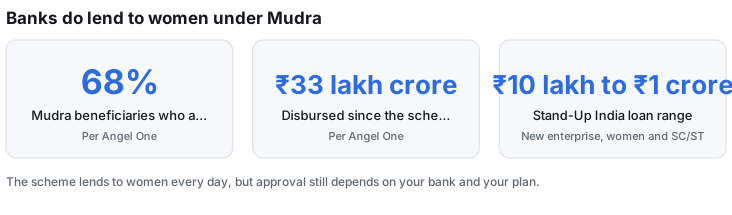
Stand-Up India. This scheme is for women and SC/ST entrepreneurs starting a new business outside farming. Wikipedia's summary gives the loan range as ₹10 lakh to ₹1 crore, for a new enterprise in manufacturing, trading or services. It's aimed at larger starts than most home businesses, so it suits you if your plan needs real equipment or a shop.
Udyam registration. It's the government's registration for micro, small and medium businesses. The Udyam portal says it is free and that you should pay no one for it. Lenders and marketplaces often ask for it, so do it early.
Ask your bank which of these it offers before you plan around any of them.
Saree reselling, in more detail
Saree reselling is the idea on the list where stock matters most, so it needs the most planning. A tutor can start tomorrow. A reseller has to decide what to buy.
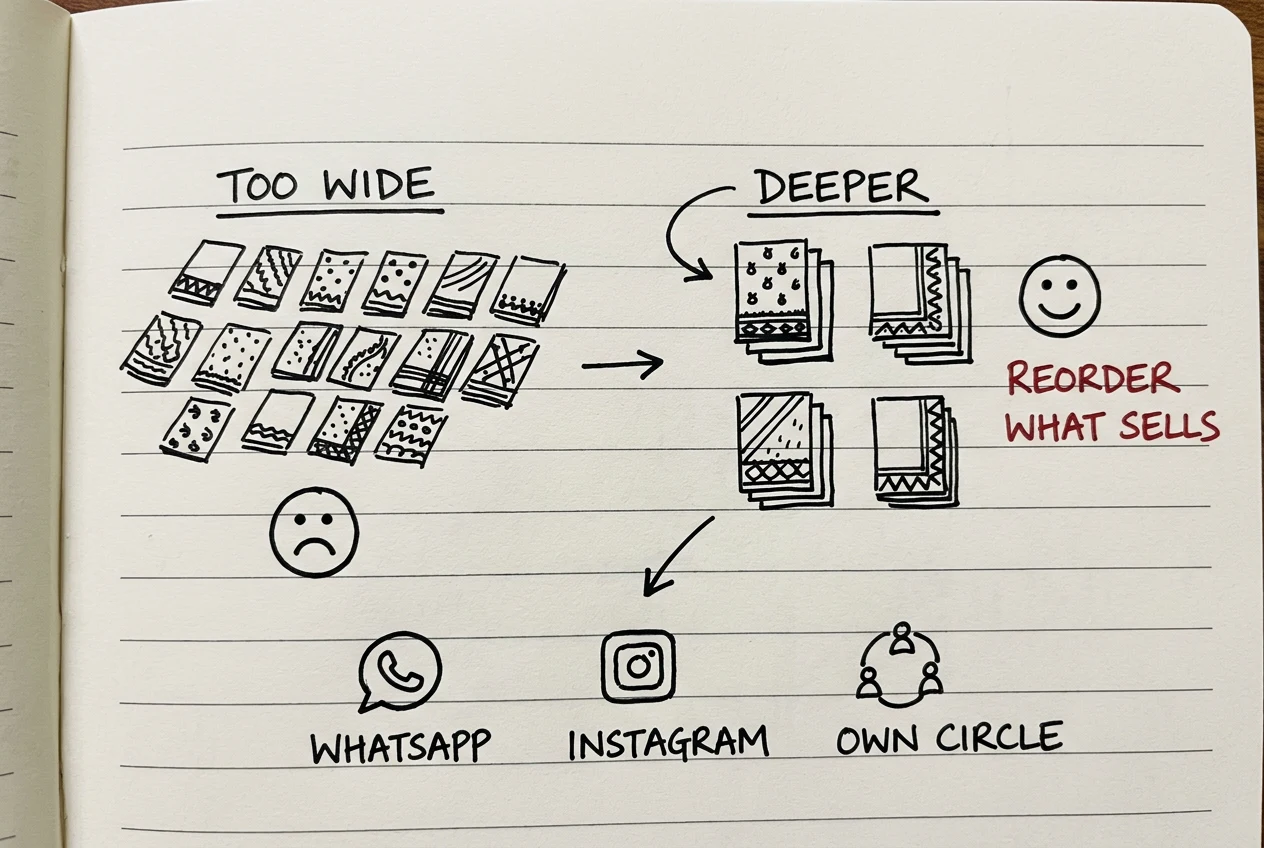
The usual mistake is buying one of everything. Twenty designs, one piece each, means no design gets enough chances to sell, and it's hard to photograph and describe so many. It's better to hold fewer designs in more depth and to learn from the first sales what your buyers ask for, because that tells you what to reorder before you've spent the rest of your money.
Where you sell changes the plan:
- WhatsApp. Good for your first buyers. Send three new pieces in a weekly broadcast, with a clear photo and the fabric named.
- Instagram. Good for showing a range. Draped photos in daylight sell better than flat ones.
- Your own circle. Relatives, neighbours and colleagues are your first ten buyers. Ask them what they'd wear to the next wedding.
For the full cost breakdown with three budget plans, read How to Start a Saree Business: Cost, Profit & Steps. If you're deciding between loom types, Powerloom vs Handloom Silk Sarees: How to Split Your Stock explains the split.
Buying direct from the maker
silksaree.shop is the trade name of Kenche Mallikarjuna, a saree house in Rayadurg, on the Andhra Pradesh and Karnataka border. The family has worked in the saree trade for over 100 years. They sell designer silk sarees wholesale to saree shops, boutiques and resellers across India.
For a woman starting a reselling business, these are the useful points.
- Boxed sets of 28. One set is the minimum order, so it suits you once you have buyers waiting. If you're still at the start, you could share a set with two or three others, though that's my suggestion and not an arrangement the supplier offers, so settle it among yourselves first.
- Factory rates. You buy from the people who weave. Prices are shared on WhatsApp, and Kenche Ramesh replies himself.
- Your own design. They also weave to order in your colours, border and motif. Ask about quantity and timing on WhatsApp.
- Dispatch across India. You don't need to live near Rayadurg.
Most of these sarees are woven on power looms and some on handlooms, so ask which is which before you order. To start, message Kenche Ramesh on WhatsApp at +91 94409 21080, or on Instagram at @kencheramesh. Send your town, how many sets you want and the colours your buyers ask for. Payment is agreed on WhatsApp.

A few short reels from the maker's own Instagram, @kencheramesh, show what a set looks like.
FAQ
What are the best business ideas for women?
The best ones match a skill you already have and buyers you can reach. For most women starting out that means home food, tutoring, tailoring, gifting or reselling. The table above lists all ten with what each needs to start.
Which business can a woman start at home with low investment?
Services such as tutoring, freelancing, virtual assistant work and social media help need the least money, because your time is the main input. Home food needs only basic equipment and the right registration.
Can women get a loan to start a business in India?
Yes. Schemes such as Mudra and Stand-Up India lend to women, and 68% of Mudra beneficiaries are women. Approval depends on your bank and your plan, so ask the branch what it offers.
Do I need to register my business?
It's worth registering on Udyam early, since it's free and lenders and marketplaces often ask for it. Some businesses, such as food, need extra permissions. Check with your local office before you sell.
Is selling sarees a good business for women?
It can be, if you start with a small range, learn from your first sales and plan stock around weddings and festivals. It goes wrong when you buy too many designs at once.
What to do next
Write down your free hours and the cash you can risk. Pick one idea from the table and list your first ten buyers by name. If that idea is sarees, send Kenche Ramesh a WhatsApp message with your town and the colours your buyers ask for, then compare what he says with other suppliers before you decide.