
Kanjivaram Silk Saree: How to Tell a Genuine One
23 October 2026 · silksaree.shop · 11 min read
తెలుగులో చదవండిGoogle Translate
In short: A genuine Kanjivaram silk saree is handwoven in Kanchipuram from mulberry silk and zari, with an interlocked border. Ask about the zari, feel the border joint, and check the labels.
Most South Indian brides and wedding guests ask for a Kanjivaram silk saree by name. It gets copied a lot too. If you are about to spend real money on one, you need a plain answer to a plain question: how do I know this one is genuine? Below are the labels, the cloth, the border and the zari to check, then what the fakes look like and how to keep a good one for years.
What "Kanjivaram" actually means
Kanjivaram, Kanjeevaram and Kanchipuram are three spellings of the same thing: silk sarees from the town of Kanchipuram in Tamil Nadu. The name is protected. The Tamil Nadu government applied for a Geographical Indication (GI) in 2005, and the Government of India recognised it in 2005-06. A GI means the name belongs to a place, so a saree woven somewhere else shouldn't be sold under it.
The same source says the sarees are woven from pure mulberry silk and zari, both sourced from South India, and that about 5,000 families were involved in the work as of 2008.
So the first question for any seller is simple: where was this woven, and can you show it in writing?
The labels: GI tag and Silk Mark
Two labels matter, and they answer different questions.
- The GI tag speaks to the place. It tells you the saree is meant to come from the Kanchipuram weaving area.
- The Silk Mark speaks to the fibre. It is run by the Silk Mark Organisation of India under the Central Silk Board, and it attests that a textile is pure natural silk.
A Silk Mark does not tell you where a saree was woven, and a GI tag does not tell you how much zari is in it. Ask for both. The Silk Mark is advisory, not a law, so a missing label is a reason to ask more questions, not proof of a fake. Keep the tag and the bill together.
Pure mulberry silk
Genuine Kanjivaram is woven in mulberry silk. It is thicker and more tightly twisted than the fine silk used for light sarees, so the cloth has body. It hangs heavy, holds a pleat and rustles a little when you rub it. Sellers call that sound "scroop".
Polyester blends and art silk copy the shine but not the body. They feel slippery or plastic, and they drape limply. Rub a corner between your fingers in daylight. Real silk warms up and feels dry and a little crisp, not cold and slick.
Real zari versus tested zari
Zari is the metallic thread in the border, the pallu and the buttas. It is also where most of the price, and most of the cheating, sits.
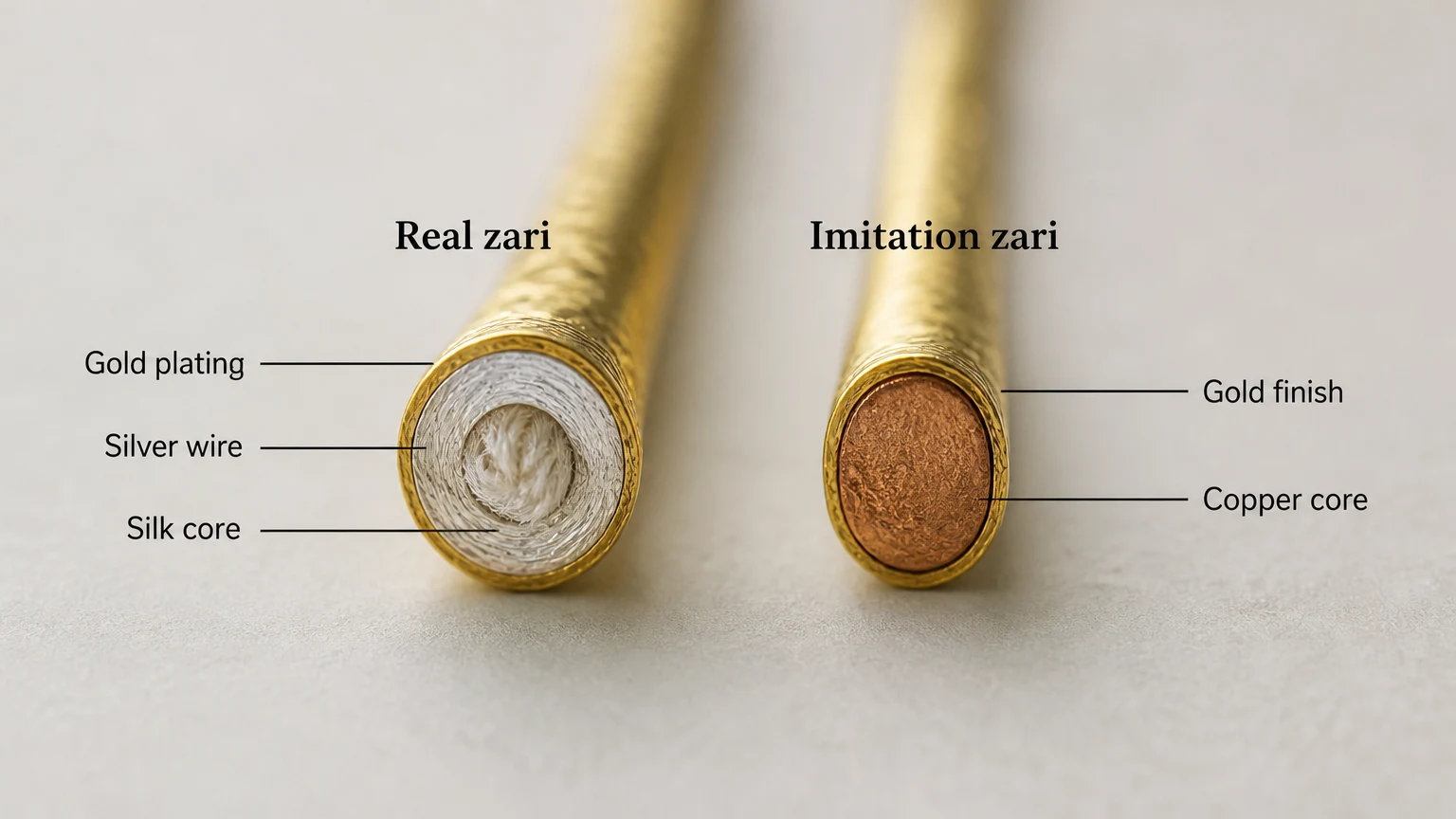
Real zari is a silk core wrapped with a flat silver wire, plated with gold. Cheaper zari uses a copper core with a gold-coloured finish. In between sit grades sellers call 2G, 1G and "tested" zari. One retailer's guide says only pure zari keeps any resale value from its metal. It also says tested or imitation zari has none, and the name "1G" alone doesn't prove any gold.
You can't lab-test a saree in a shop. So ask:
- Is this zari pure, or tested or imitation?
- Does it carry any precious-metal value if I resell it?
- Can that be written on the bill?
Look at the zari too. Real zari sits in the cloth and has a soft, warm glow. Imitation zari often looks glassy and too yellow. Pure and 2G zari can darken with time, while imitation zari usually shows age later. A darkened border on an old saree is not always a fake. It is often just silver aging.
Zari is a large share of the cost of a heavy saree. One textile journal says it can be up to 60% of the raw-material cost. That is why a saree priced very low with a wide, heavy border should make you stop and ask.
The korvai border and the contrast pallu
This is the part most people can check with their own fingers.
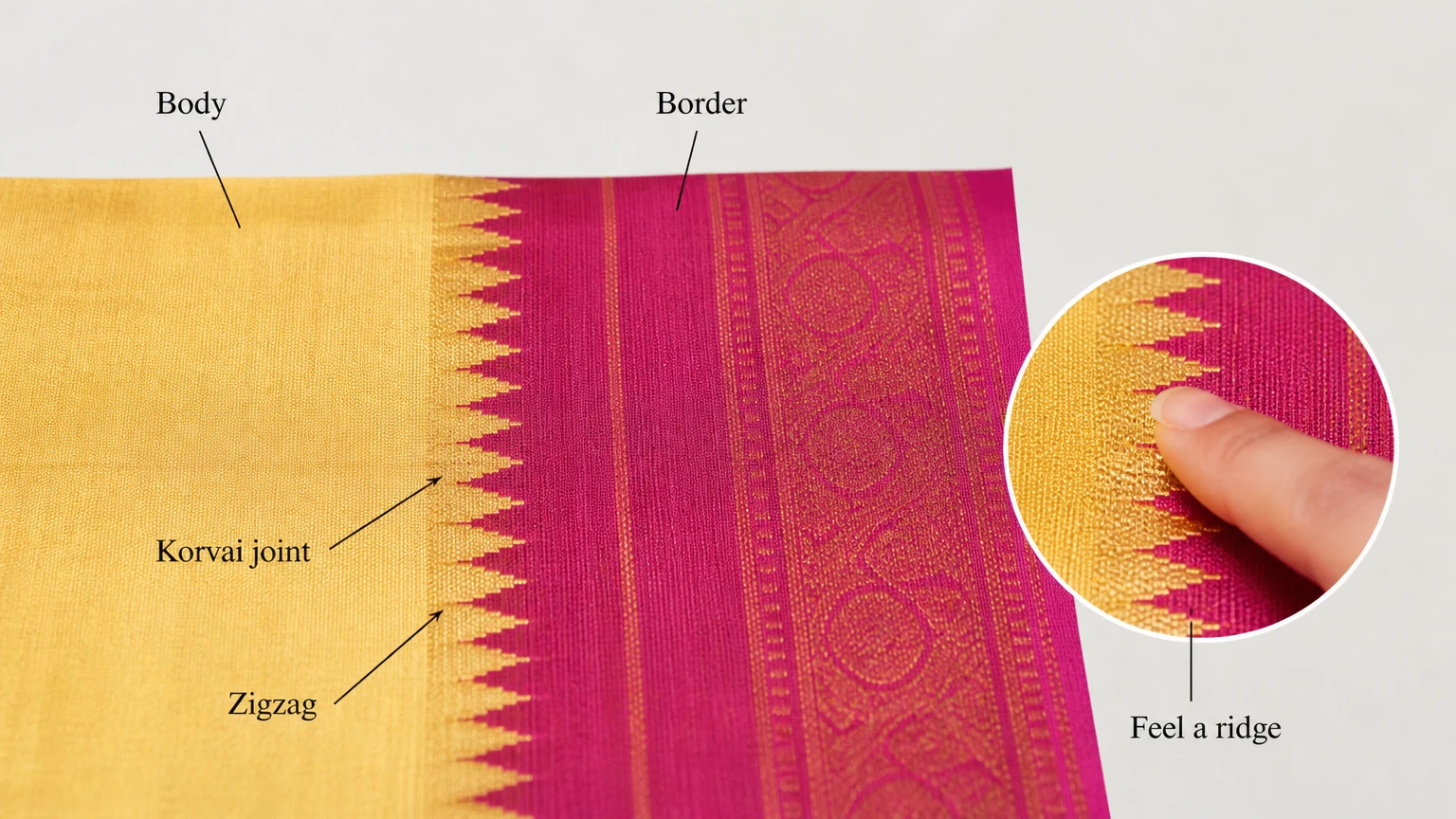
In a Kanjivaram, the body and the border are woven separately and then interlocked, a technique called korvai. The joint is strong enough that the border won't come away even if the body tears. A zigzag line often marks where the body meets the pallu.
Check it:
- Run a finger along the border joint. You should feel a slight ridge or step where two sets of warp meet.
- Look for the zigzag. Where the border meets the body, the line is often jagged, not a straight cut.
- Hold the border to the light. In a printed or stitched-on copy, the "contrast" is on the surface and the back looks like the front, flat and uniform.
- Check that the border really contrasts. A wide, deep contrast border is typical. The pallu is often a different colour from the body, with heavy zari.
Lie the pallu flat. It should not pucker or curl at the edges.
Weight and handfeel
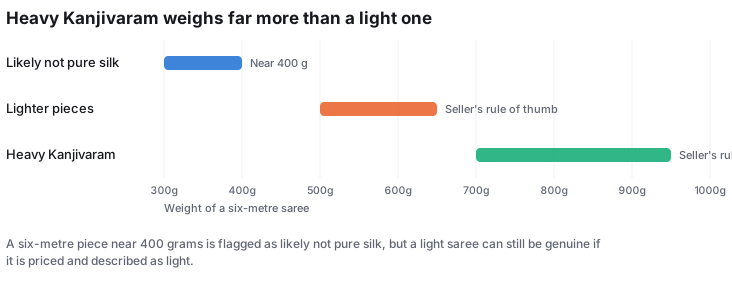
A genuine heavy Kanjivaram is noticeably heavy. One retailer's guide says a six-metre heavy piece weighs about 700 to 950 grams, and lighter pieces are often 500 to 650 grams. It calls one near 400 grams likely not pure silk. These are a seller's rule of thumb, not a standard, and a lighter saree isn't a fake. A light one can be perfectly genuine, but it should be priced and described as light.
If you can, ask to weigh it. A kitchen scale is not rude. A reputable seller won't mind.
The common fakes
| What you may be sold | What it really is | What gives it away |
|---|---|---|
| Powerloom sold as handloom | Machine-woven, possibly in silk | Very even threads, a very clean back, motifs identical from piece to piece |
| Art silk | Viscose, rayon or polyester | Slippery, light, little rustle, a plastic drape |
| "Kanjivaram-style" | A look-alike from elsewhere | No korvai ridge, border printed or stitched on |
| Imitation zari | Copper core with a gold finish | Glassy, too bright, tarnishes quickly |
"Kanjivaram-style" and "Kanchipuram design" are the phrases to listen for. They sound like a promise and say nothing. A powerloom saree can still be good silk, but it isn't the same thing as a handloom one, and you shouldn't pay a handloom price for it. If you want to understand that split before you shop, read Powerloom vs Handloom Silk Sarees: How to Split Your Stock and Handloom Sarees: What Makes One Handloom, and How to Buy.
How to check a Kanjivaram silk saree before you buy
No single test settles it. Run the whole list and treat each failure as a question for the seller.
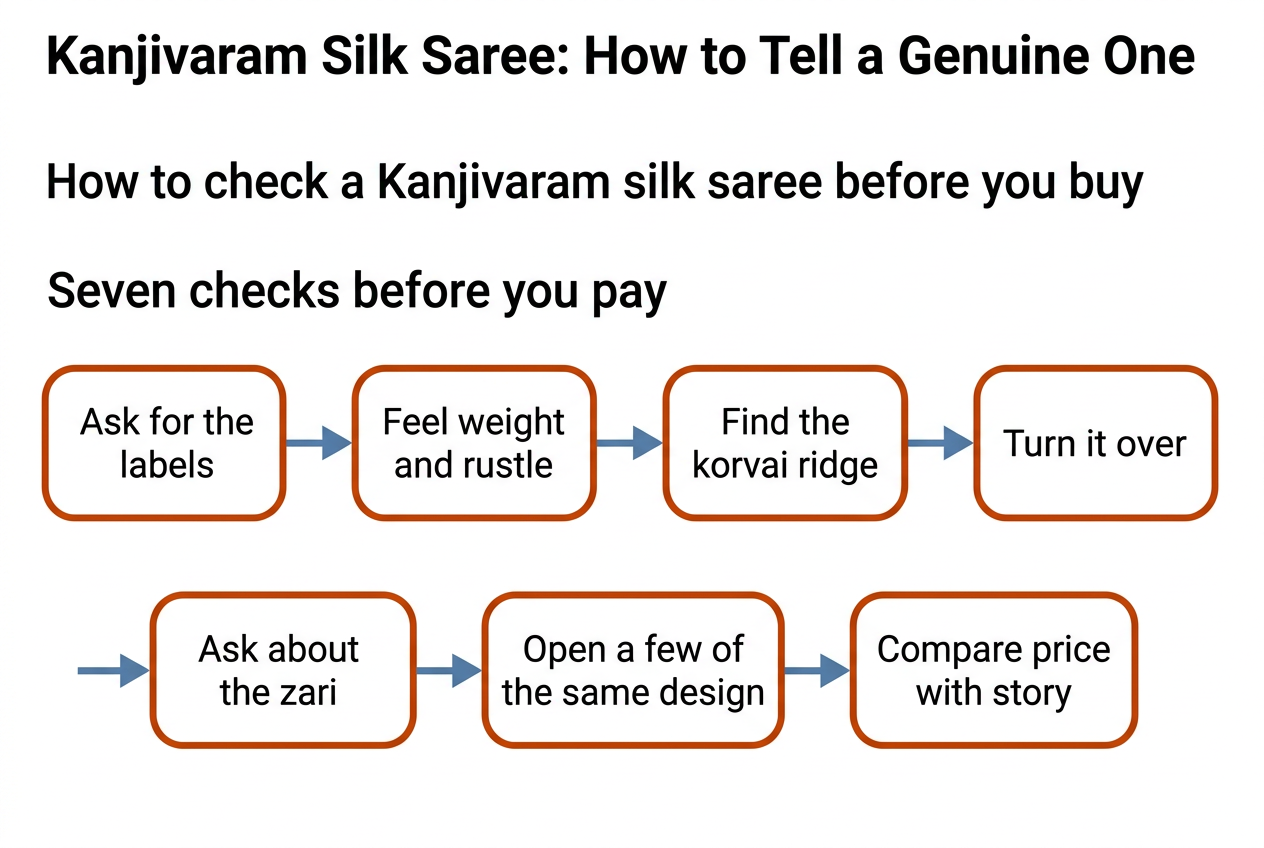
- Ask for the labels. GI details and the Silk Mark, in writing.
- Feel the weight and the rustle. Heavy, crisp, dry.
- Find the korvai ridge along the border.
- Turn the saree over. Handweaving leaves small differences, and the back is not perfectly tidy.
- Ask about the zari. Pure, 2G, or tested, written on the bill.
- Open a few of the same design. Pieces that match to the last motif point to a machine.
- Compare the price with the story. A saree sold as heavy, pure-zari, handloom Kanjivaram at a very low price doesn't add up.
A burn test or scratch test is often suggested online. Don't do it on a saree you haven't bought. Sellers won't allow it, and it damages the cloth.
What drives the price
Rather than quote figures that vary by shop and season, here is what moves the price, roughly in order of weight:
- Zari. Pure zari costs far more than tested or imitation zari, and the amount of zari matters as much as the grade.
- Silk weight and quality. More mulberry silk, and a tighter twist, means more cost.
- Design intricacy. A plain body with a simple border takes a weaver far less time than a pallu with large figures. Work of that kind can need two people at the loom.
- Dye and colour. Deep, rich shades cost more to get right than light ones.
- Handloom or powerloom. The loom is a real part of the price.
Before you buy, set your budget and ask which of these five a saree is paying for. If a seller can't say, that is your answer.
Popular motifs and colours
Kanjivaram designs draw on South Indian temple art, scripture and nature. The classics:
- Temple borders (the gopuram, or temple-tower, pattern)
- Checks and stripes
- Floral motifs and large buttas
- Peacocks, swans, lions and elephants, especially in the pallu
Some pallus show paintings by Raja Ravi Varma or scenes from the Mahabharata and Ramayana, according to the same source.
On colour, brides lean towards deep reds, maroon, green and royal purple with gold or silver borders, as one buying guide puts it. Turmeric yellow, temple red, peacock green and saffron are common for festivals. Peacock blue, teal, wine and mustard suit a wedding guest, who usually doesn't want to match the bride.
Kanjivaram, Banarasi and Mysore silk
| Kanjivaram | Banarasi | Mysore silk | |
|---|---|---|---|
| Where | Kanchipuram, Tamil Nadu | Six districts around Varanasi, Uttar Pradesh | Mysore, Karnataka |
| Cloth | Heavy mulberry silk, contrast korvai border | Brocade with raised zari patterns | Smooth mulberry silk, light and soft |
| Look | Bold temple motifs, strong contrast | Dense floral and vine patterns | Plain or with a thin zari border |
| Made by | Weavers across the Kanchipuram area | Weavers in the Banaras GI districts | Karnataka Silk Industries Corporation |
In short, Kanjivaram is the heaviest and boldest, Banarasi the most ornate, and Mysore silk the lightest. The Mysore article also says KSIC weaves a unique ID, a hologram-based design and a barcode into each saree, so it's easier to verify than most. For the north Indian side of this comparison, see Banarasi Silk Sarees: What Makes One Genuine, and How to Check.
How to care for and store a Kanjivaram
A heavy silk saree lasts decades if you treat it kindly.
- Wash rarely. A heavily zari-worked piece is best dry-cleaned. For a light one, follow the steps in How to Wash Silk Sarees at Home, Dry, Iron and Store Them.
- Never wring it, and dry it flat in shade.
- Iron on low heat through a cloth, and never press directly over the zari.
- Store in soft cotton or muslin, not plastic, which traps damp.
- Air it every few months, away from direct sun, and refold along new lines. Zari wears and cracks along old creases.
- Keep it away from perfume and hairspray when you wear it. Put the saree on last and take it off first.
FAQ
How do I know if a Kanjivaram saree is real? Check three things together: the labels (GI details and Silk Mark), the korvai ridge along the border, and what the seller says about the zari. None is enough alone.
Does a real Kanjivaram always have a Silk Mark? No. The Silk Mark is voluntary. A missing one is a reason to ask more, not proof that the saree is fake.
What is the difference between Kanjivaram and Kanchipuram? Nothing. They are different spellings of the same name for sarees from Kanchipuram.
Is real zari silver or gold? Real zari is a silk thread wrapped in flat silver wire and plated with gold. Cheaper zari uses a copper core with a gold finish.
Why is a Kanjivaram so heavy? Because of thick, tightly twisted mulberry silk and a lot of zari. A very light saree sold as a heavy Kanjivaram should make you ask why.
Is a powerloom Kanjivaram a fake? Not necessarily fake silk, but it isn't a handloom saree, and it shouldn't be priced as one. Ask which it is and get it in writing.
Which colour is best for a wedding? Brides often choose deep red, maroon, green or royal purple. Guests tend to pick peacock blue, teal, wine or mustard.
Can I wash a Kanjivaram at home? A light piece, yes, in cold water with mild soap. Dry-clean one with heavy zari.
What to do next
Before you buy, write down your five questions: where it was woven, whether the silk is pure, which zari it has, whether it is handloom or powerloom, and whether the labels are on the bill. Ask them of every saree you like, and see how the seller answers.
To see how a saree house in Rayadurg describes its own weaving, silksaree.shop sells designer silk sarees wholesale in sets of 28 and takes enquiries on WhatsApp. Its sarees aren't sold as Kanjivaram.